
Pushing Its Own AI Tool? Amazon Restricts Third-Party Price Comparison Sites from Displaying Historical Price Data
Ebrun Original, July 19th: According to recent foreign media reports, Amazon has begun requesting its affiliate marketing partners to stop displaying historical price data for products on price comparison websites. This change means that channels for consumers to use third-party tools to determine whether Amazon product prices have recently increased will be significantly narrowed.
Amazon confirmed to the media that the company has requested price comparison sites participating in the Amazon Associates program to "ensure that Amazon product prices no longer appear in price tracking charts or price alerts, in accordance with the signed partnership agreement."
Prior to this, some price comparison websites in Western Europe had revealed weeks ago that they received email notifications from Amazon, instructing them not to display or track Amazon product historical prices in any form. These platforms not only delete user reviews involving Amazon prices one hour after posting but are also prohibited from sending any email alerts to users about Amazon product price changes.
In response to external inquiries, Amazon later provided a supplementary statement.
The company stated that Amazon has not universally prohibited price comparison sites from displaying historical price data but has indeed requested those Associates partners whose business model includes price comparison websites to ensure that Amazon product prices do not appear in price tracking charts or price alert features, as per the agreement.
Amazon emphasized that this requirement targets how price information is used in specific tools, not a blanket ban on partners displaying historical prices. However, the company did not provide further explanation for the specific reasons behind this request.
Currently, it is unclear how extensive this policy adjustment is—whether it applies only to Western Europe, is expanding to more countries, or applies to all price comparison sites that have joined the Amazon Associates program—as no clear response has been provided.
The direct consequence of this change is that consumers will find it more difficult to determine whether a product's price has recently been increased by Amazon.
On Amazon's official website, such historical price information is not readily accessible. The discount percentage displayed by the platform is typically calculated based on the product's suggested retail price, not referencing the product's lowest price in the past 30 days.
This means that even if a product's price was recently raised, its product page may still carry a "discount promotion" label, easily misleading consumers into thinking they are getting a genuine deal.
Notably, while restricting third-party displays of price history, Amazon itself is accelerating its own deployment of this feature.
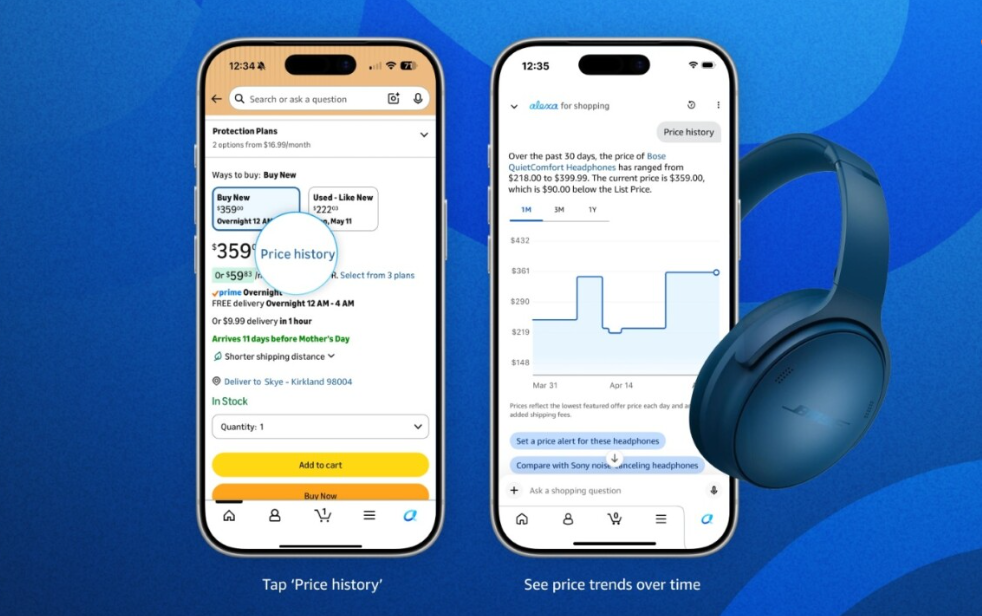
Just a few weeks ago, Amazon officially announced that its built-in AI shopping assistant, Alexa for Shopping, has launched price history query services for 30-day, 90-day, and even 365-day periods in markets including the US, UK, and India. Regular customers can view this for free three times per month, with convenient access methods: they can either directly click the "Price History" link next to the price on the product detail page or summon the Alexa shopping icon in the shopping app and ask, "What's the price history?"
Some analysts have pointed out that this move by Amazon may be creating a "reserved area" for promoting its official AI tool.
When third-party price comparison tools are required to remove Amazon prices from price tracking charts and alerts, Amazon's own price history query feature becomes the most direct official channel for consumers to obtain such information. The connection between these events, although not yet officially confirmed by Amazon, has sparked considerable market speculation due to the timing overlap between the policy tightening and the promotion of the official tool.
Ebrun will continue to follow up and report on this development.

[Copyright Notice] Ebrun advocates respecting and protecting intellectual property rights. Without permission, no one is allowed to copy, reproduce, or use the content of this website in any other way. If any copyright issues are found in the articles on this website, please provide copyright questions, identification, proof of copyright, contact information, etc. and send an email to run@ebrun.com. We will communicate and handle it in a timely manner.
Translated by AI. Feedback: run@ebrun.com