
Temu's Traffic Halved? SHEIN Nearly Exits? European Tariff Policy Cuts Platform Ad Spending Significantly
[Ebrun Original] July 13 News: Data from European e-commerce marketing research firm SMEC shows that since the EU officially began charging a new fee of 3 euros per item for imported parcels valued under 150 euros starting July 1st, cross-border e-commerce platforms with Chinese backgrounds have begun adjusting their European advertising strategies. Citing Google Shopping data, SMEC pointed out that Temu's ad exposure has dropped by about half, while SHEIN has almost completely withdrawn from Google Shopping ad auctions. This is to avoid new fees being levied on parcels still in transit when they arrive at the EU border. Meanwhile, the proactive reduction in ad spending by major cross-border platforms has also freed up a significant amount of advertising inventory for European local retailers. According to SMEC's analysis, Google Shopping is a crucial marketing channel for Temu, SHEIN, AliExpress, and hundreds of M2C (Manufacturer-to-Consumer) companies and cross-border e-commerce platforms from East Asia. The advertising behavior of these players is highly sensitive to market environment changes, and the fluctuations in their paid ad exposure can fully reflect their willingness and capability to continue investing in the European market. SMEC noted that the core reason for the sharp decline in ad spending is the new tariff collection mechanism. Customs duties are not determined by when the consumer places the order or when the seller ships the item, but by when the parcel arrives at the EU border. The shipping cycle for Chinese cross-border sellers typically takes several days or even weeks. The closer it got to the July 1st policy implementation date, the higher the risk that parcels already in transit would incur the new fee. Therefore, platforms had to reduce ad spending in advance; otherwise, a large number of already sold goods could face unpredictable additional costs during customs clearance. To assess the policy's impact on cross-border e-commerce platforms, SMEC analyzed data from about 500 European Google Shopping advertisers, counting how many ad accounts were in direct auction competition with platforms like Temu and SHEIN to measure the ad spending scale of these platforms.
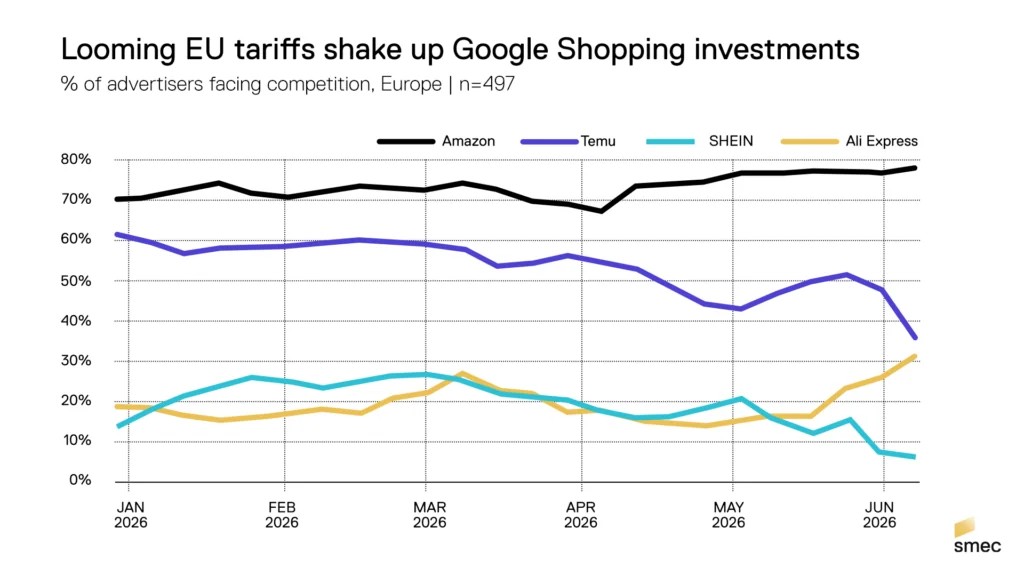
Since March 2026, the proportion of advertisers competing directly with Temu and SHEIN has been declining.
Data shows that in early 2026, the three companies maintained a relatively high overall level of ad auction coverage on Google Shopping. Temu's coverage remained above 70%, and SHEIN, although slightly lower, also maintained a significant market presence, with both fluctuating only within a narrow range for most of May. Subsequently, the three companies showed clear divergence. Temu's coverage curve began a sustained and gradual decline from late May, dropping to about half of its March level by late June. SHEIN exhibited a completely different trend: its spending remained relatively stable until late May, but in the final days of May, its ad auction coverage suddenly plummeted, almost to zero, and remained there until the end of the observation period in late June. The most unexpected variable came from AliExpress. Unlike the continued retreat of the other two, AliExpress actually increased its ad investment during the same period, approaching Temu's competitive level for the first time this year. SMEC speculates that AliExpress may have aimed to capture as many orders as possible before the July 1st policy took effect, but this was undoubtedly a high-risk strategy. It should be noted that Temu and SHEIN are only representative samples. In fact, dozens of smaller-scale Chinese cross-border sellers may also be simultaneously reducing their ad budgets. Therefore, from a broader market perspective, the contraction in ad spending by Chinese cross-border sellers is likely more pronounced than what the charts show. Meanwhile, the significant reduction in ad spending by Chinese cross-border platforms has left a gap in the Google Shopping market. However, this gap did not last long. The fastest-moving competitor was Amazon. According to its official schedule, Amazon Prime Day was held simultaneously in 26 countries from June 23rd to June 26th, a promotional period that highly overlapped with the window of rapid ad spending contraction by Temu and SHEIN. SMEC believes this timing overlap is not coincidental, noting that just as many Chinese e-commerce advertisers were withdrawing from Google Shopping auctions, Amazon was ramping up its ad budget to its annual peak. Furthermore, SMEC highlighted another noteworthy phenomenon. During the period when Temu and SHEIN were reducing ads, Joybuy, the cross-border e-commerce platform under JD.com, had already quietly begun participating in Google Shopping ad auctions weeks before officially announcing its entry into the European market. This case demonstrates that as long as a company is willing to invest, new entrants can quickly establish a presence within the Google Shopping ad auction system. As leading players contract, the competitive landscape of the European e-commerce advertising market is undergoing a rapid reshuffling.
Ebrun continues to track this development. To learn more about information related to this article, please scan the QR code to follow the author's WeChat.

[Copyright Notice] Ebrun advocates respecting and protecting intellectual property rights. Without permission, no one is allowed to copy, reproduce, or use the content of this website in any other way. If any copyright issues are found in the articles on this website, please provide copyright questions, identification, proof of copyright, contact information, etc. and send an email to run@ebrun.com. We will communicate and handle it in a timely manner.
Translated by AI. Feedback: run@ebrun.com