
NAVO's Robot Ambition Begins with 'Eyes', Securing Over 60 Million Yuan in Orders Within 9 Months
Ebrun Original: 'The Dreame ecosystem provided us with an excellent starting point, encompassing global branding and channels, a technological foundation, talent density, and supply chain capabilities.' Reflecting on the rapid completion of the company's commercialization loop, Mao Song, founder of the NAVO (Lingzhi Wujie) brand, candidly summarized.
In July of last year, the NAVO brand was officially established (spun off from the Dreame system). By September, it had completed its first funding round of 25 million yuan. Product sales began in December, and by May this year, the company had secured over 60 million yuan in orders. Starting from the third quarter of this year, NAVO is set to enter an accelerated growth phase, including launching new products and achieving scaled expansion in the global market.
Currently, NAVO has completed an additional Series A funding round worth tens of millions of yuan. According to the plan, this round of funding will be continuously invested in product R&D and will be used to get the growth flywheel spinning—'accelerating from 60 million to 600 million yuan.'
The journey from 60 million to 600 million yuan in revenue will also represent NAVO's product evolution from 'security cameras' to 'home care robots.' As Mao Song puts it, NAVO positions itself as 'a visual robotics brand driven by AI algorithms at its core.' However, the product realization path is divided into three stages: 'see clearly—understand—interact.' Currently launched products are only at the first stage of achieving 'see clearly'—security cameras.
Why would a company aiming to make robots start with cameras? In the consumer robotics track, how is NAVO different from other brands? Incubated within the Dreame ecosystem, how will NAVO establish independence and survive? Ebrun had an in-depth discussion with Mao Song around these questions.
01
Remaking a Red Ocean Category with New Technology
Currently, NAVO's mass-produced and sold products include several indoor and outdoor security cameras. Taking the representative high-end product, the NAVO X10 series, as an example, its debut earned the 'Annual Innovation Honoree Award' at IFA 2025. After its official launch, with product highlights such as one-click physical privacy, night vision capabilities, and a solar fast-charging solution, it quickly gained market traction.
The choice to start with security cameras is based on NAVO's independent assessment of its opportunity. In Mao Song's view, the development of a category generally goes through three periods: 'market demand validation—supply chain support (technology feasibility)—large-scale commercialization.' For a startup, launching a product that is better than competitors' during the third period significantly increases the probability of success and allows for achieving a commercial loop with relatively less capital investment.
Consumer security cameras have been validated as having genuine demand over many years, the industry's supply chain capabilities can be quickly leveraged, and traditional manufacturers have already achieved large-scale commercialization. Precisely at this time, a major variable emerged—the rapid advancement of AI technology—allowing NAVO to see an opportunity to create differentiated products.
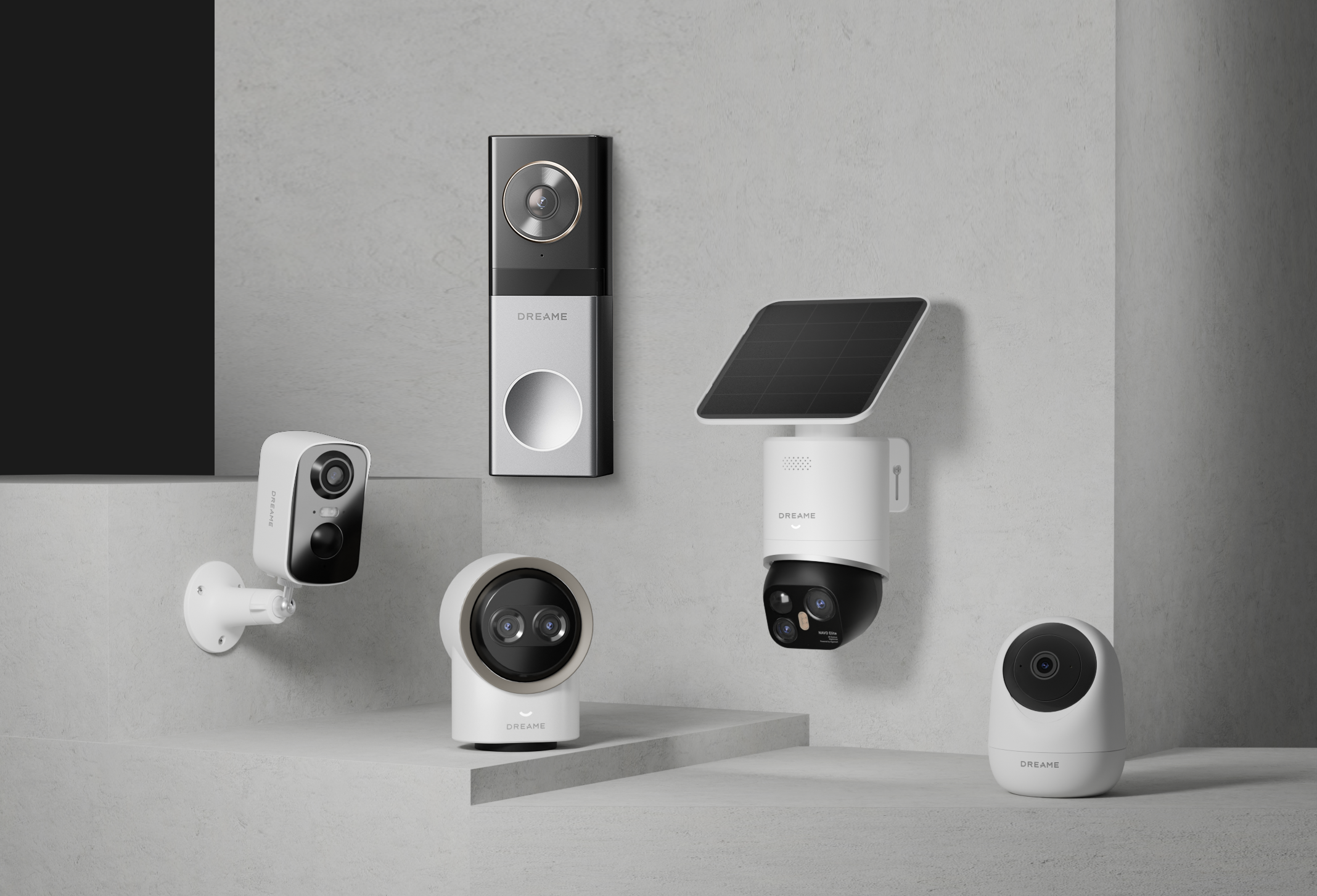
'This track has seen nearly two decades of development and has become relatively solidified, a veritable red ocean. But by deeply integrating AI algorithms, the entire category can be revitalized,' Mao Song explained. 'This aligns with what Dreame often calls 'N+1'—building upon the industry's mature benchmark product (N) and making a precise innovation (+1) that addresses a perceptible key pain point and commands a premium.'
Specifically, traditional security cameras mostly focus on hardware-level innovation, aiming to solve the problem of 'seeing.' NAVO, through hardware-software integration innovation (e.g., using an F1.0 aperture in hardware, relying on AI-ISP chips for image processing, enabling products to display full-color, smooth images under extremely dark conditions of 0.001 Lux, achieving industry-leading performance), upgrades 'seeing' to 'seeing clearly.' Simultaneously, it lays the groundwork for 'understanding'—being able to identify people, vehicles, pets, and even deeper features like expressions and emotions.
It is reported that in terms of core technology, NAVO has built a proprietary security chip architecture (including edge AI computing power, an AI-ISP intelligent image processing engine, and an edge real-time inference architecture), possesses a black light full-color night vision engine, and pioneered the event-level AI platform AlgoMart in the industry. All these enable NAVO's cameras to go beyond mere 'seeing.'
'There are no such products on the market currently; we are definitely the first,' Mao Song confidently stated. 'This is also why our positioning is not home security, but rather home visual intelligence hardware.' Of course, this also sets the stage for NAVO's second and third-stage products.
02
Evolution from Security Cameras to Home Robots
NAVO's AI event-level recognition capability upgrades cameras from 'identifying objects' to 'understanding events,' enabling precise identification of complex scenarios such as elderly falls, pet intrusions, and package deliveries, reducing invalid alarm rates by 70%. This ability to pre-filter complex scenes is precisely the key to reducing the computational load on the 'brain' of future embodied intelligent robots. As Mao Song summarized NAVO's product roadmap: creating embodied intelligent robots starts with 'vision.'
Traditional robot manufacturers often follow a 'act first, perceive later' path. NAVO does the opposite: first building the 'machine's eye' and 'machine's brain' to solve the perception problems of 'seeing clearly' and 'understanding,' then endowing them with mobility. Security cameras represent the 'machine's eye.' The home security brain is set to be released in the third quarter of this year, and the home care and companionship robot, which truly enables interaction, is expected to be released in the first quarter of next year.
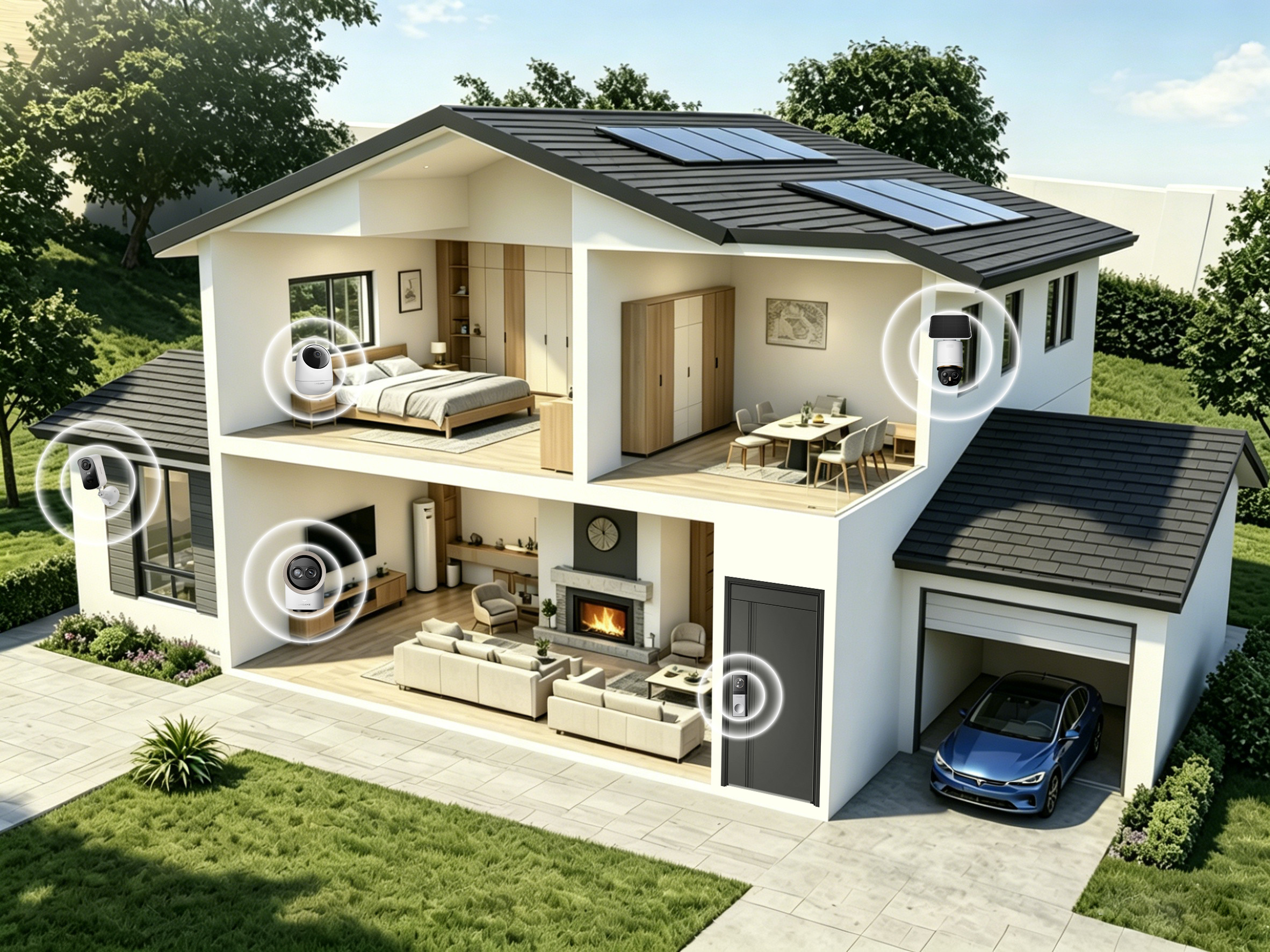
Mao Song revealed to Ebrun that NAVO's second-stage product—the home security brain—in terms of product form, is a 'box' equipped with a screen/tablet. After connecting to home cameras, the cameras act as terminals capturing information, which is then sent to the 'box' for analysis and processing. Users can then obtain valuable core information from the 'box' through semantic input.
As for the third-stage robot products, currently in preparation, they include a bipedal care robot targeting the elderly user group—focusing on health monitoring and round-the-clock companionship—and a quadrupedal robot dog. The latter can move to a specified location to help users complete a task upon receiving a command (a typical application scenario: when a camera identifies a courier delivering a package to the doorstep, the robot dog will go and retrieve it).
In Mao Song's view, embodied intelligent robotics is a track with a sufficiently large market size. However, currently, there are hardly any products on the market with the capability to truly enter homes and help users solve specific problems. Most players launch products that first 'develop muscles' and achieve mobility, then search for user pain points and solve adaptation issues within a specific scenario—this is the logic of 'looking for a nail to hit with a hammer.' NAVO, however, is 'looking for a hammer for the nail'—identifying the needs and pain points in home care and companionship scenarios first, then defining the product through AI technology.
'Consumer-grade embodied intelligence needs to possess the ability to recognize three-dimensional spaces in different scenarios, acquire multi-dimensional physical information, input it into the brain for precise decision-making. After recognizing information, it must also meet users' specific needs and provide emotional value. Only then can robots truly integrate into home environments,' he added.
When asked how NAVO differs from other brands making home robots, Mao Song stated that the chosen path determines the possibility of success. 'We follow the product planning path of 'vision first, then brain, then body.' This path itself is scarce. Simultaneously, this path ensures we can form a commercial loop at each stage, meaning each stage has the ability for self-sustaining growth.'
03
Incubated from the Dreame System, How to Become an Independent Global New Brand?
'Born global' is almost a consensus among the new generation of consumer-grade smart hardware companies, and NAVO is no exception.
Moreover, compared to some overseas brands that start with a single national market, NAVO operates in multiple markets in parallel from the outset. Leveraging Dreame's global layout, NAVO possesses inherent channel advantages. Currently, Dreame has over 6,500 offline stores worldwide covering core commercial districts across more than 120 countries and regions. This allows NAVO products to effectively reach global users through Dreame's channel capabilities.
It is reported that based on overall order signing, NAVO's products have been launched in nearly 30 countries—the breadth has basically reached the current stage's target. The next step is to more specifically 'go deep.' In other words, NAVO will, based on the markets already developed, thoroughly connect the entire chain from B-end to C-end, involving product pricing systems, localized marketing strategies, and omnichannel coordination.
'We don't make any assumptions about which market necessarily holds the greatest opportunity. Instead, we see which market emerges first, then invest more resources to scale it up,' Mao Song said. From the perspective of the new stage, NAVO's strong markets are primarily in Europe and America.
'Standing on Dreame's shoulders,' NAVO may run faster than other startups, but it also means that for a long time, it will be labeled as 'Dreame's NAVO' rather than the independent 'NAVO.' Regarding this, Mao Song stated that having Dreame's endorsement can significantly lower the trust barrier for users towards NAVO and extend Dreame's brand reputation and premium capability. In the future, when NAVO accumulates sufficient core technological capabilities, continuously enriches its own product portfolio, and strengthens its recognition among consumers, then the brand's 'de-Dreame-ification' will happen naturally.
'I hope that in the end, the market will recognize NAVO as a startup with independent value that emerged from the Dreame ecosystem,' Mao Song concluded.
[Copyright Notice] Ebrun advocates respecting and protecting intellectual property rights. Without permission, no one is allowed to copy, reproduce, or use the content of this website in any other way. If any copyright issues are found in the articles on this website, please provide copyright questions, identification, proof of copyright, contact information, etc. and send an email to run@ebrun.com. We will communicate and handle it in a timely manner.
Translated by AI. Feedback: run@ebrun.com