
The 'Second Spring' for Cross-Border E-commerce Independent Stores: AI Era, Value Reassessment

By He Yang
[Ebrun Original] A single-quarter GMV surpassing the $100 billion mark for the first time—this is the new high set by Shopify in the first quarter of this year.
This SaaS player, which once rallied under the slogan of 'arming the Amazon rebels' to provide e-commerce infrastructure for millions of merchants globally, pushed the concept of decentralized e-commerce to its peak, making the independent store model immensely popular. Today, it is fully committed to telling the story of AI-powered e-commerce, and, judging from its financial report data, initial results are emerging.
The 35% year-over-year growth to $100 billion in single-quarter GMV is closely tied to Shopify's comprehensive upgrade of its AI tool matrix and its heavy bet on Agentic Commerce.
During the earnings call, Shopify's management pointed out that the penetration rate of its merchant-side AI assistant, Sidekick, is rapidly increasing, with significant operational efficiency improvements. The number of weekly active stores grew fourfold year-over-year, and in the first quarter of this year alone, merchants created over 12,000 custom applications through Sidekick. Simultaneously, the Shopify Catalog product data infrastructure is now capable of serving AI agent commerce at scale. As of the first quarter, it has completed the structured processing of information for over 1 billion products, providing standardized, readily accessible product data for AI agents. The AI-driven search traffic resulting from this has a conversion rate twice that of general AI search traffic.
Whether it's providing AI assistance on the operational side for merchants or introducing AI-driven traffic on the sales side, it makes running an independent store sexy again—at least, when facing the future of commerce, independent stores are embracing AI fast enough. As the driving force behind the independent store ecosystem, Shopify has also found a new growth lever.
Of course, it's not just Shopify. Several independent store SaaS platforms well-known within the cross-border e-commerce industry, such as Shoplazza and SHOPLINE, are also placing their bets when facing the new variable of AI. Transforming from 'e-commerce SaaS' to an 'AI-native commerce operating system,' building commercial infrastructure for the AI era, seems to have become the common path forward for breaking through bottlenecks.

What has Shopify done to 'build bridges and pave the way' for AI e-commerce?
'Shopify enters the AI era with a clear lead—strong and sustained growth, plus 20 years of e-commerce data, these two things set us apart in the industry. By 2026, this advantage will be compounded,' said Shopify President Harley Finkelstein regarding the first-quarter performance.
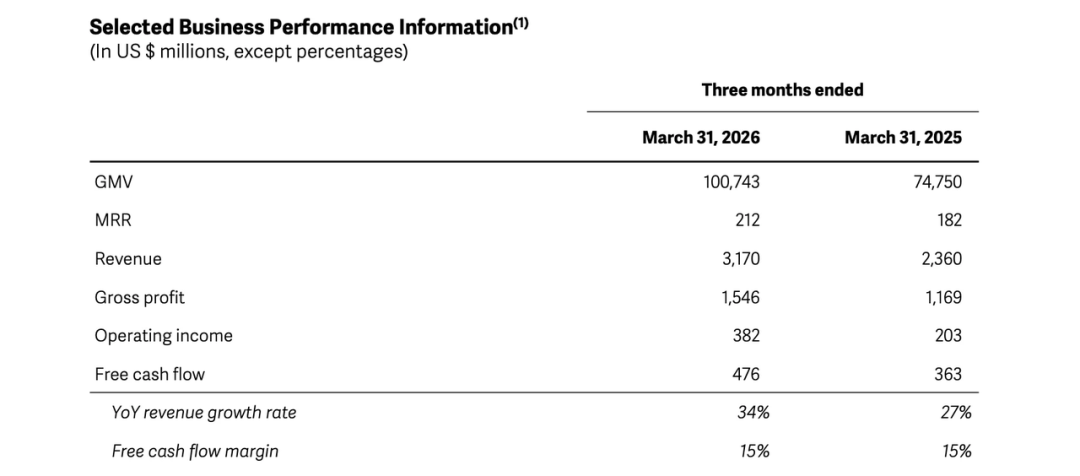
Image: Key data from Shopify's Q1 financial report this year
He also stated, '2026 will be the year of the builders, and we will fully empower them—from the first order to full-scale growth.' What Shopify is currently doing is 'building bridges and paving the way for the new era of AI e-commerce'—providing merchants, developers, and partners with AI and full-stack e-commerce infrastructure.
Currently, Shopify has undertaken a series of actions around its AI strategy and product innovation, which can be broadly categorized into three areas:
1. Comprehensive deployment of Agentic Commerce (also known as intelligent agent commerce, where AI agents shop on behalf of consumers, completing the entire process from need identification, product search, price comparison, negotiation to order placement and payment), enabling independent store merchants to sell products on AI platforms.
Shopify believes AI chat is the next frontier for e-commerce—where consumers discover products is shifting from traditional search engines to various AI conversational interfaces, and Shopify aims to allow merchants to seamlessly access the latest AI channels 'out of the box.' To this end, in December 2025, Shopify officially launched 'Agentic Storefronts.' It helps merchants on the Shopify platform be accurately and quickly discovered on AI platforms like ChatGPT, Perplexity, and Microsoft Copilot.
This is supported by three components: Shopify Catalog (Shopify's product library), UCP (Universal Commerce Protocol), and a unified management backend. Shopify Catalog uses real signals from millions of merchants and products to structure data, enabling AI to discover and understand products; UCP is an open standard protocol jointly launched by Google, Shopify, Walmart, Etsy, and other e-commerce platforms to solve interaction issues between AI agents and e-commerce platforms/merchants; the unified management backend allows merchants to configure once and sell their products across all AI conversational 'fronts,' managing orders cross-platform and attributing sales independently by AI channel.
2. Systematically upgrading AI tools, transforming AI from a 'passive responding assistant' to an 'active decision-making partner.'
In using AI to help merchants improve operational efficiency, Shopify has two core products—Magic and Sidekick. Magic is a suite of integrated, free AI features that can generate product descriptions, create marketing images, handle email marketing, edit social media copy, provide intelligent customer service responses, and more. This year, it also introduced new features like 'Brand Tone Clone.' Sidekick is a conversational Agent. Merchants can open a chat sidebar on any page in the backend, describe in natural language what they want to do, and it will plan, execute, and report results.
When Sidekick debuted a few years ago, it was just a simple chatbot. However, after Shopify's major version update at the end of 2025 (Shopify Edition Winter '26, featuring over 150 functional upgrades), Sidekick was transformed, evolving from passive response to active decision support. For example, Sidekick Pulse can proactively monitor and analyze data, pushing operational adjustment suggestions in the backend; conversational editing allows merchants to modify store designs simply by speaking; custom app generation enables building tailored mini-apps within the management backend to handle specific internal workflows.
3. 'Opening up' externally, allowing merchants to introduce AI 'experts' to take over operational tasks.
In April of this year, Shopify announced the launch of the AI Toolkit for merchants and developers, allowing mainstream AI tools like Claude Code, Cursor, Gemini CLI, Visual Studio Code, and Codex to integrate into the Shopify ecosystem via plugins, Agent Skills, or MCP (Model Context Protocol).
In other words, Shopify allows merchants to bring external AI Agents into their independent store backends to handle various store operations. Previously, merchants needed to pay for Shopify plugins or outsource these tasks and hire corresponding operational staff. Now, they can simply issue simple commands or integrate corresponding Skills to complete the work.
This series of 'AI transformations' is clearly effective: data shows that since 2025, AI-driven traffic to Shopify stores has grown eightfold year-over-year, and orders originating from AI search have increased approximately thirteenfold. Various AI tools make independent store operations simpler, more efficient, and lower-cost, further lowering the barrier to entry for merchants; while integrating with AI channels gives independent stores access to unprecedented, currently low-cost new traffic. Reflected in Shopify's own performance, more merchants entering the market and more merchants becoming active naturally drive the growth of its core metrics like MRR (Monthly Recurring Revenue, a key revenue indicator for SaaS subscription businesses, measuring predictable recurring monthly income).

SaaS Platforms Advance to 'AI-Native E-commerce Operating Systems'
Shopify is quite representative, but in this wave of AI, no one wants to fall behind. As one industry insider put it: 'Currently, globally, SaaS is viewed pessimistically, with only AI remaining. It's not a matter of one or two years, but the next five to ten years, so we must stay at the table.'
Beyond Shopify, taking SHOPLINE and Shoplazza, two mainstream players in the cross-border independent store ecosystem, as examples, increasing investment in AI strategy and redefining their value is a consensus.
In November last year, at the '2025 SHOPLINE Global Ecosystem Co-creation Conference,' SHOPLINE officially launched the new SHOPLINE OS 3.0 theme. The core message was to provide a systematic growth foundation for brand globalization with stronger performance, a more open ecosystem, and end-to-end AI capabilities.
According to SHOPLINE's official introduction, in terms of AI empowerment, leveraging its privately deployed large model capabilities, it has implemented multiple intelligent products such as online smart customer service and site-building coding assistants, with an adoption rate exceeding 90%; AI-powered search, recommendation, and advertising plugin features bring merchants over ten million dollars in natural conversion sales weekly; simultaneously, it is advancing conversational shopping experiences for consumers, improving user interaction on independent stores in a results-oriented manner.

Regarding introducing new traffic from AI channels to independent stores, SHOPLINE platform data shows that AI channel visitor numbers and traffic increased approximately 775% and 675% year-over-year respectively, with the average conversion rate up 53.9% year-over-year. The AI channel's share of GMV is currently only 0.068%. The low base and low share behind the high growth rate indicate the vast incremental potential of AI e-commerce channels. 'We have rich tools and AI-friendly structured data supporting large models in ingesting multimodal data, allowing merchants to acquire more GEO/AEO traffic,' said a relevant person in charge at SHOPLINE.
Furthermore, in May this year, SHOPLINE partnered with Accio Work, an AI Agent workbench for cross-border business under Alibaba, to launch the 'SHOPLINE Store Builder' plugin. Through three major AI Agents, it helps merchants more simply and quickly complete tasks like site building, product listing, and development via conversation.
Shoplazza officially launched its AI-native e-commerce operating system (AI-native commerce OS) in April this year, simultaneously rolling out an AI Agent intelligent product matrix, such as the site-building agent Shoplazza AI, visual creation agent LazzaStudio, advertising agent AdValet, and operations management agent Athena, forming an Agent collaboration system to break down data silos and fragmented processes.
A relevant person in charge explained: 'In the past, Shoplazza served over 650,000 merchants globally as a professional SaaS platform; today, relying on AI-native architecture and agent technology, it integrates previously fragmented and dispersed cross-border services into a unified intelligent system. AI capabilities are deeply embedded in the entire business scenario of cross-border independent stores, from setup to growth, achieving a closed loop of 'demand input – intelligent generation – automatic execution – continuous optimization.'
Perhaps each company's expression and pace differ, but their attitude towards the variable of AI is consistent—grasping it is the ticket to the next season. They also clearly understand that truly building 'e-commerce infrastructure for the AI era' is not simply about adding AI features to existing businesses.
'Although no one can clearly describe the final form yet, it's certain that everything from the underlying architecture, product logic to interaction methods must be reconstructed with AI as the foundational 'utility' to be considered a true AI-native e-commerce operating system, or AI-native commerce ecosystem,' an industry insider pointed out.

Reassessing the Value of Independent Stores: Who Can Seize the New Opportunity?
There is no doubt that numerous SaaS platforms have significantly lowered the barrier to entry for independent stores. In the early days, merchants had to deploy and code themselves to create an independent store; the emergence of platforms like Shopify almost turned 'site building' into an 'out-of-the-box' experience.
The period roughly from 2020 to 2022 was when independent stores received the most attention from Chinese globalizing merchants. At that time, influenced by some leading players, the potential of independent stores became visible to more people, while the drawbacks of third-party platforms were magnified. Various SaaS platforms emerged, collectively supporting the rapid development of the cross-border e-commerce independent store ecosystem.
Behind this is the DTC model that independent stores embody, which is precisely suited to the current environment for globalizing merchants—evolving from overproduction and rapid circulation to a more controllable supply chain and a more private, community-based operational model.
However, disillusionment with independent stores soon set in. One practitioner stated bluntly: 'The entry barrier for independent stores has been lowered, but the barrier to truly making them successful remains high. Considering the operational difficulty and cost comprehensively, many small and medium-sized sellers realized this wasn't something they could just casually succeed at.' After 2023, coupled with the rise of new platforms like TikTok, Temu, and SHEIN offering merchants more choices, independent stores gradually cooled down.
But today, a new quantitative change is emerging again.
From the perspective of the rise of AI Agentic Commerce, the question merchants must answer is: when consumers no longer open search engines or e-commerce platforms but directly ask AI for shopping advice, can their brand and products appear in the conversation? And what 'Shopify-like' platforms must answer is: can their value to merchants evolve from helping them open stores to ensuring they can be seen, understood, and transacted with by AI?

In other words, if the previous generation of SaaS platforms lowered the barrier to building independent stores, then the new generation of independent store service providers driven by AI, or 'AI-native e-commerce operating systems,' aim to lower the operational barrier for independent stores to near zero, while also helping merchants secure positions from the perspective of new traffic introduction.
Currently, independent stores indeed seem to be the first to reap the benefits of AI traffic. For example, ChatGPT's e-commerce checkout function integrated with Shopify first, giving merchants running independent stores not only free new traffic but also direct sales conversion.
According to public data, as of December 2025, ChatGPT's monthly active users reached 880 million, and related estimates suggest that 2.1% of ChatGPT conversations in 2025 involved product purchases. Based on this, the total transaction volume potentially driven by the ChatGPT AI platform alone is already considerable. And the numbers are still growing; as of May this year, ChatGPT's global monthly active users have surpassed the 1 billion mark.
Furthermore, in the AI era, independent stores will also take on more tasks in brand building. According to analyses by several digital marketing service providers, brand independent sites hold considerable weight in AI information sources. Generally, AI will first search for information on the brand's official website, then look for verification across the web. The content assets of an independent store are controlled by the merchant; product description pages, FAQs, brand stories, etc., can all be understood and referenced by AI.
Of course, this will also be a reshuffling. When AI brings technological democratization to independent stores and a shift in traffic entry points, whether it's large corporations, small teams, or even 'one-person companies,' in a sense, they all stand on the same starting line. Their supporting service providers—the transforming 'Shopify-like' platforms—are similar.
Ebrun continues to track and report on this development. To learn more information related to this article, please scan the QR code to follow the author on WeChat.

[Copyright Notice] Ebrun advocates respecting and protecting intellectual property rights. Without permission, no one is allowed to copy, reproduce, or use the content of this website in any other way. If any copyright issues are found in the articles on this website, please provide copyright questions, identification, proof of copyright, contact information, etc. and send an email to run@ebrun.com. We will communicate and handle it in a timely manner.
Translated by AI. Feedback: run@ebrun.com