
In Conversation with MOVA's Li Jian: What Drove the Smart Robotic Lawn Mower to Global Market Leadership?
[Ebrun Original] The EBRUN Global Goods · Interview is a global product archive constructed by Matiti Club × Ebrun. We delve into the front lines of corporate R&D and manufacturing, aiming to deconstruct the pioneers of 'good products' that are redefining user preferences amidst the wave of overseas expansion. We don't just document stories; we also attempt to review the key decisions and user insights behind each product.
By Ebrun, Siyang.
Outside the MOVA headquarters building in Suzhou, on a neatly trimmed lawn, over a dozen smart robotic lawn mowers were parked, with staff members bending over to adjust them. 'This is just one of our many testing scenarios,' Li Jian, Global President of MOVA Smart Garden, told Ebrun.
Since its founding in 2020, public perception of MOVA might still linger on 'robotic vacuum cleaner brand,' but currently, smart robotic lawn mowers have become its largest business segment. In 2025, its first smart robotic lawn mower product officially launched to market. In just one year, MOVA captured a 40% share (online and offline combined) in the European robotic lawn mower market, becoming the category leader; as of May 2026, MOVA's cumulative shipments have exceeded 500,000 units, with this year's target set at 1 million units.

On a track where pioneers had already validated the market, yet widespread user experience pain points persisted, how did MOVA's smart robotic lawn mower manage to come from behind and take the lead?
With this question, Ebrun engaged in an in-depth dialogue with Li Jian, Global President of MOVA Smart Garden.

'The 'Stake-Planting' Pain Point: Why Pioneers Garnered Praise but Not Sales'
When MOVA entered, there were already pioneers ahead in the smart robotic lawn mower race.
'Some sold products at prices as high as over 2000 euros per unit, which shows the market demand is real,' Li Jian said. 'But the return rate was as high as 10%-20%.'
Why was that? The problem lay in the mismatch between product technology roadmap and application scenarios.
At that time, most products on the market used RTK (Real-Time Kinematic) technology—a GPS-based real-time dynamic positioning solution. It uses a reference base station for 'error correction,' reducing positioning errors from several meters to a few centimeters. With this, a robotic lawn mower could follow a planned path straight, without wandering or colliding.
This mature technology from high-precision surveying, transplanted to robotic lawn mowers, sounded promising. But placed in the gardens of European users, its critical flaw was exposed.
Li Jian explained that European cities are relatively crowded, with few open yards. Coupled with users' strong emphasis on boundaries and privacy, obstructions are the norm. Finding a location with both a power source and an open, unobstructed area to plant the base station stake for satellite signal reception often required running a long cable, or even climbing onto the roof. Hiring a professional for installation added another 700 euros to the cost.
Such a product was only suitable for the 'handy' users willing to read manuals and not averse to tinkering. 'But this is something only a very niche, technically savvy group can manage,' Li Jian said. 'For the average user, a product requiring such high intervention is destined not to achieve mass adoption.'
The pioneers captured this group—they craved change, were willing to take risks for new technology, and even enjoyed being 'the first to try.' But this group, as described by Silicon Valley strategist Geoffrey·Moore in his book 'Crossing the Chasm,' constitutes at most 16% of the market. The real mainstream users are another type: they want 'someone else to have used it, proven it works well, and for me to be able to use it right away.'
Li Jian believes many innovative products don't fail due to poor technology but get misdirected by the rhythm set by early adopter geeks, failing to cross into the mainstream market. MOVA saw the opportunity in this chasm and chose to start directly with the mainstream users.

The 1000 Euro Price Point: A Precise 'Entry Point' for Mainstream Users
Since the target was the mainstream user group, the first strategic question was: where to strike?
MOVA didn't initially chase the 2000 euro high-end market—users were too niche—nor did it dive headfirst into the 500 euro low-end market—margins were too thin to sustain subsequent R&D.
Li Jian's choice was: enter at the around 1000 euro price point—the most concentrated range acceptable to the mainstream user group in Europe. The logic behind this was clear:
First, the market size was large enough. Gardens under 600 square meters are the mainstream configuration for middle-class European families, and the size of this group far exceeds those with super-large lawns.
Second, it was winnable. Pioneers were focused on the high-end niche market, while the 1000 euro price segment was less competitive. MOVA could concentrate all its resources to achieve absolute leadership in this sub-segment.
Third, it offered a matching value proposition. Li Jian did the math: For a 600 sqm garden in Europe, the annual cost of hiring someone to mow is roughly 600-1000 euros. A product priced at 1000 euros corresponds to a 'one-year payback period,' making the user's decision threshold relatively low.
Simultaneously, addressing the pain points of pioneers' products in European garden scenarios, MOVA decisively chose a product innovation path based on LiDAR (Light Detection and Ranging) and made extremely restrained hardware trade-offs for the product. Li Jian pointed out: 'We specifically developed a new, custom sensor for this scenario with intentionally limited peak performance, yet sufficient to meet users' normal usage scenarios.' Combined with optimizing costs of other non-core modules, this enabled MOVA's first smart robotic lawn mower to achieve delivery beyond expectations at the 1000 euro price point.
In its first year, this product sold 70,000 to 80,000 units. MOVA's entry point was validated by mainstream consumers voting with their wallets.

Why Did LiDAR Win? Users Buy an 'Ultimate Experience'
The preceding RTK solution's technological foundation wasn't actually poor; the problem was user experience—installation required planting stakes, running cables, debugging, and there was a risk of losing signal, leading to persistently high return rates.
'LiDAR doesn't need signals; it perceives the environment by emitting laser beams and receiving reflected signals. Standing in place, it can scan an area with a radius of over 70 meters, covering tens of thousands of square meters, which is sufficient for 90% of European user scenarios', Li Jian said, 'The richer the garden's structure and the more obstructions, the better LiDAR performs.'
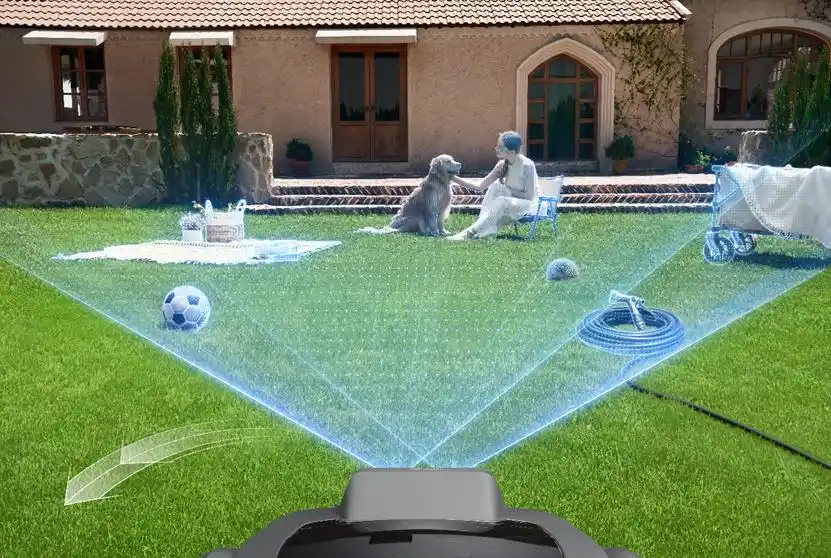
The user unpacks the box, places the machine in a corner of the garden, plugs it in, and it starts working on its own. No stakes to plant, no signals to find, no professional installation required.
Li Jian believes the underlying thinking here is a re-understanding of 'what are users really buying?' Mainstream users aren't buying a 'powerful technology'; they're buying a 'worry-free outcome.' They want a stable, reliable, complete solution they can take home and use immediately. If any link is missing—troublesome installation, cumbersome after-sales service, frequent need for manual intervention—they won't buy it, let alone recommend it to friends.
'Easy to use, easy to get started with, and not expensive—that's how you expand your user base.' Li Jian repeated this phrase.
In his view, the advantage LiDAR brings over RTK isn't being 'a bit better' on some technical parameter, but achieving a difference several times better on the dimension of 'what the user needs.'
And the support behind this is the accumulation of systematic capabilities. 'Opportunities to disrupt the market solely based on one absolutely unique technology aren't particularly common. What we need to do is make the experience better and control costs more optimally based on existing foundations, optimizing across all dimensions.'

From Focus to Expansion, Moving from 1000 Euros to the Full Price Spectrum
After securing a foothold at the 1000 euro price point beachhead, MOVA began extending upwards and downwards.
Upwards, it launched 1500-2000 euro four-wheel-drive flagship models, pioneering in the industry the combination of 'LiDAR positioning + stereo vision + 4WD + dual blade discs + edge trimming,' specifically designed for steep slopes and large-area lawns. Downwards, it introduced entry-level pure stereo vision robotic mowers around 500 euros, allowing budget-conscious users to also adopt smart robotic lawn mowers.
'2000 euros is the pinnacle, 1000-1500 euros is the mid-range, 500 euros is the base,' Li Jian said.
One might ask: Didn't you emphasize focus? Why spread out now? Li Jian's explanation: Focus isn't the goal; it's to gain a foothold first. And after gaining a foothold, expansion is necessary; otherwise, you end up confining yourself. This is precisely the 'Bowling Alley' phase described in 'Crossing the Chasm'—after you knock down one pin (a niche market), you can't stop; you must use its momentum to knock down the next pin. Each fallen pin helps knock down the next.
Expansion isn't returning to a 'casting a wide net' mode; it's using the beachhead as a center point to extend precisely and rhythmically into adjacent markets. Each new market is closely related to the existing stronghold: technologically homologous (LiDAR, vision solutions), overlapping user profiles (middle-class garden owners), and reusable channels (online + offline retailers, DIY stores).
MOVA's expansion succeeded primarily due to two prerequisites:
First, costs could be reduced. The first product's annual sales of 70,000-80,000 units drove down LiDAR costs from over 2000 yuan to over 500 yuan. 'With volume, we can push the supply chain. The ultimate moat for a hardware company is the supply chain.'
Second, pricing must be accurate. The three price tiers each have their role: the high-end focuses on technology, locks in profits, and builds the brand; the mid-end drives volume and defends the core market; the entry-level uses algorithms to reduce hardware costs, capturing scale and expanding share.
Now, based on four underlying platforms, MOVA has launched over ten product models, covering the full price spectrum from 500 to 2000 euros. The market responded quickly: entering 2026, MOVA's sales in core European markets grew exponentially—year-over-year sales increased by 2360% on Amazon Germany and 1290% in Italy, with online momentum continuously igniting; simultaneously, it also consistently ranked first in sales in major European retail chains like BAUHAUS. The 40% market share was achieved by knocking down one pin at a time.

Next Stop: From Mowing to More Garden Scenarios
Beyond the residential market, the commercial market is already in MOVA's expansion plans for smart robotic lawn mowers, such as professional turf maintenance for golf courses, football fields, etc. Also, after achieving leadership in Europe, the US market is the next major growth point. It is reported that the MOVA LiDAX Ultra smart robotic lawn mower topped the Amazon US Best Sellers list just three months after launch.
For MOVA's entire smart garden business, new growth curves also lie in expanding from robotic lawn mowers to more categories within garden living scenarios.
'Our core capability is robotics R&D capability—algorithms, positioning and navigation, motion control,' Li Jian said. Currently, MOVA Smart Garden's main focus remains robotic lawn mowers—to deeply penetrate and dominate this category. But gardens also have pools, barbecues, irrigation, and other scenarios where robot capabilities can be gradually extended in the future.
Currently, MOVA's robotic pool cleaner has already launched. Its approach differs slightly from the robotic lawn mower—entering directly into the high-end market, differentiating with edge-cleaning capabilities and adaptability to complex terrains (4WD + four propellers, supporting pools with sloped steps) to establish product strength.
A garden robot with a robotic arm is also under development. Li Jian described it: chassis plus robotic arm, solving all garden maintenance tasks requiring 'hands'—corner trimming, hedge maintenance, planting/watering flowers, weed removal, even interacting with pets. These are tasks European and American garden owners would typically pay someone to do. Measured against labor costs, users' willingness to pay has a very high ceiling.
Li Jian stated that MOVA only enters categories where the market is large enough (tens of billions scale) and where there is potential for intelligent transformation. A smart garden barbecue grill is one example MOVA is looking at. But some categories are firmly avoided—those without technological barriers, they won't do.
'We're not expanding categories from zero, but standing on the success of the robotic lawn mower,' he added, 'using the user mindshare and channel network accumulated by the robotic lawn mower to drive the entire product line.'
This expansion logic, summarized by Li Jian, is: using validated core capabilities to attack adjacent scenarios. Each expansion isn't starting from scratch, but taking a step forward from an existing stronghold.

Li Jian, coming from a technical R&D background to taking full responsibility for product, market, and commercial results, has fully walked through a process from 0 to 1. In his view, MOVA's underlying methodology is actually a replicable framework: find a large enough market, enter early, preferably where demand has already been validated by others, then precisely carve out a niche market, capture mainstream users with a product that is 'at least twice as good' as competitors', and then use this base to continuously expand outward.
When asked for advice for Chinese brand founders embarking on globalization, Li Jian thought for a moment and said four words: 'Think, learn.' Thinking involves repeatedly digging into the essence amidst problems and phenomena; learning is constantly absorbing various professional knowledge and successful experiences.
From robotic vacuum cleaners to robotic lawn mowers, to the entire smart garden business, Li Jian's career has always revolved around the core of 'robotics.' The rise of MOVA, in his view, isn't due to someone's extraordinary talent, but because it followed some already validated principles and could flexibly apply them in practice.
Supported by systematic capabilities, reaching 10 billion yuan in revenue is the next high point for MOVA's Smart Garden business.
[Searching for 'Born Global' Ultimate Goods]
Not all products are truly good products that give consumers a sense of satisfaction! The EBRUN Global Goods 2026 Awards are searching for those 'global goods' that redefine global standards in technology, aesthetics, and consumer experience.
If your product is worthy of becoming an industry benchmark, please leave its name here.

[Copyright Notice] Ebrun advocates respecting and protecting intellectual property rights. Without permission, no one is allowed to copy, reproduce, or use the content of this website in any other way. If any copyright issues are found in the articles on this website, please provide copyright questions, identification, proof of copyright, contact information, etc. and send an email to run@ebrun.com. We will communicate and handle it in a timely manner.
Translated by AI. Feedback: run@ebrun.com