
The Strong Get Stronger? Top 1% of TikTok Shop US Sellers Contribute 60% of GMV!
Ebrun Exclusive, June 15th: A recent study by the renowned independent market analysis firm Marketplace Pulse has revealed a striking 'top-heavy concentration effect' within the TikTok Shop US seller ecosystem. The top 1% of sellers contribute a staggering 60% of the Gross Merchandise Volume (GMV), indicating that sales resources are highly concentrated among top-tier merchants.
This study covered nearly 100,000 US TikTok Shop sellers. Data shows that within the TikTok Shop US market, the group of sellers ranking in the top 0.1%—numbering fewer than 90—have each achieved an average cumulative sales volume exceeding $100 million, collectively contributing over a quarter of the platform's total GMV.
Expanding the scope to the top 1% of sellers, which totals less than 900, the vast majority are large-scale merchants with annual sales reaching tens of millions of dollars. Together, they control 60% of the platform's transaction volume. In contrast, the bottom 50% of sellers collectively contribute only about 0.1% of the GMV, indicating a relatively weak middle-tier seller base.
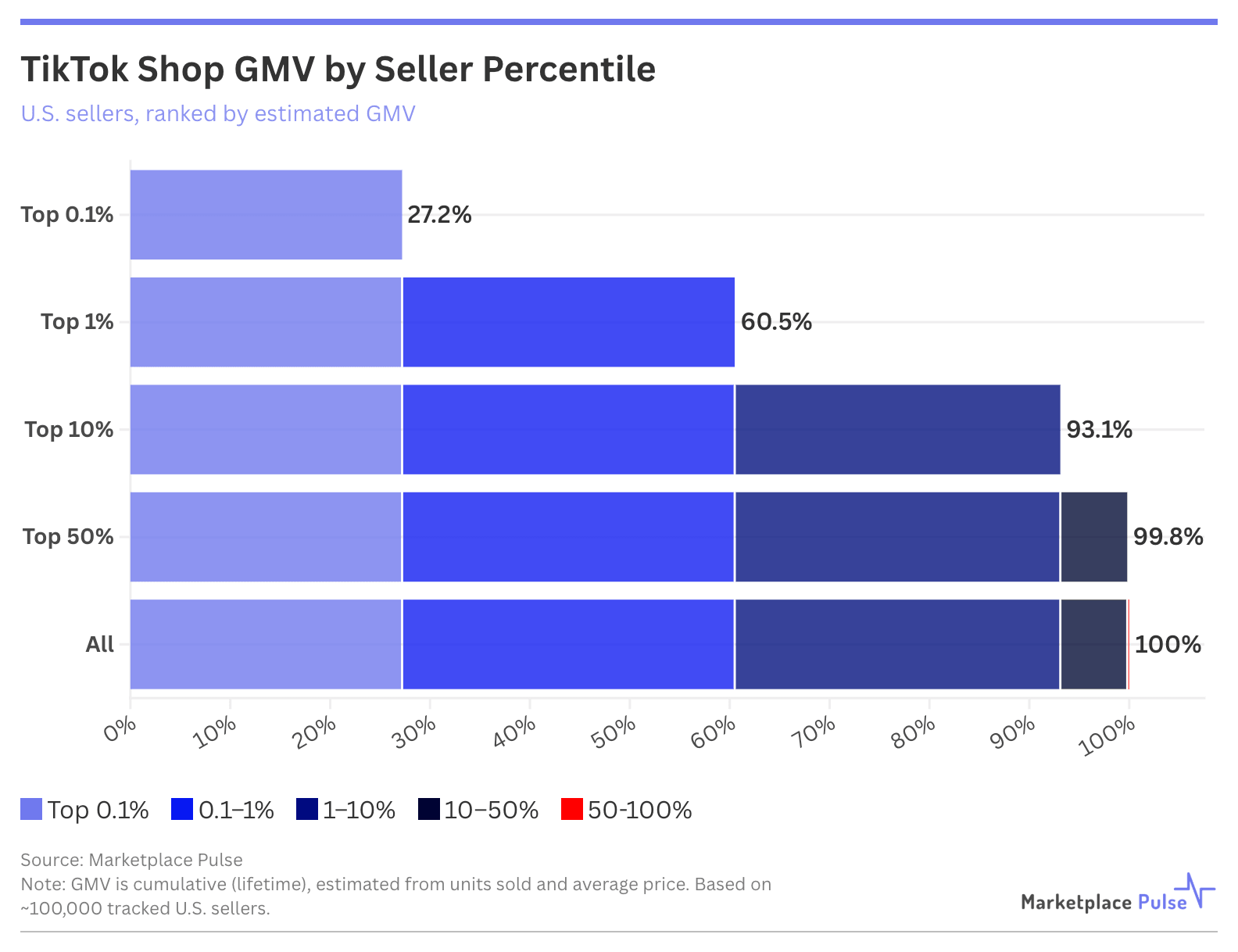
The analysis suggests that this level of top-seller concentration has surpassed that of Amazon.
On Amazon, approximately 8,000 sellers, representing about 1.6% of active sellers, contribute half of the GMV in its third-party marketplace.
However, the research firm added a note regarding the data methodology. Marketplace Pulse explained that while it has tracked nearly 100,000 US TikTok Shop sellers, providing relatively complete coverage of the platform's top sellers, data for the much larger number of long-tail sellers is still being continuously supplemented.
Furthermore, the GMV statistics here represent sellers' cumulative historical sales, not real-time data for a specific period. The calculation method estimates this based on the number of items sold and average selling prices. Therefore, these figures are better understood as a cumulative distribution of 'which sellers have captured market demand up to this point,' rather than directly reflecting current sales velocity.
As more long-tail sellers are included in future statistics and monthly/quarterly GMV data becomes more refined, the apparent contribution proportion of long-tail sellers may change. However, the research institution judges that the overall landscape is unlikely to undergo fundamental change.
Marketplace Pulse further analyzed that the platform's own operational mechanisms are reinforcing this centralization trend.
TikTok Shop awards sellers with different levels of verification badges, where 'Official Store' and 'Gold Star' represent verified and high-performing merchants. These sellers typically receive more prominent placement on the platform.
Data shows that sellers with the 'Official Store' certification have a sales scale approximately 40 times that of unverified sellers, along with higher average selling prices. Sellers with the 'Gold Star' certification have a sales scale about 18 times that of ordinary sellers.
The researchers believe that while these certifications are, to some extent, a result of a merchant's scale growth rather than the original cause of that growth, a clear positive feedback loop is formed between the two. The signals released by the platform further channel traffic and demand towards those sellers who have already distinguished themselves.
In analyzing competitive barriers, the institution pointed out that on Amazon, the keys to success are often supply chain management capabilities, operational efficiency, and capital strength. On TikTok Shop, however, this barrier becomes the 'ability to create viral hits.' This difference in driving factors may be a key clue to understanding the platform's highly stratified seller structure.
Ebrun will continue to track and report on this development. To learn more information related to this article, please scan the QR code to follow the author on WeChat.

[Copyright Notice] Ebrun advocates respecting and protecting intellectual property rights. Without permission, no one is allowed to copy, reproduce, or use the content of this website in any other way. If any copyright issues are found in the articles on this website, please provide copyright questions, identification, proof of copyright, contact information, etc. and send an email to run@ebrun.com. We will communicate and handle it in a timely manner.
Translated by AI. Feedback: run@ebrun.com