
Amazon Global Selling Unveils Five Major Trends in 'AI-Driven Cross-Border E-commerce Globalization'
Today, the Amazon Global Selling Asia-Pacific Innovation Center officially released the '2026 China Export Cross-Border E-commerce Development Trends White Paper.' This year's 'White Paper,' themed 'AI Reshapes a New Paradigm for Going Global,' proposes that the structural opportunity of 'AI-driven cross-border e-commerce globalization' has arrived and provides an in-depth analysis of five major AI application trends.
The 'White Paper' outlines the specific path of 'AI-driven cross-border e-commerce globalization,' propelled by AI and cross-border supply chain services. In the past, sellers expanding overseas followed a 'site-by-site expansion' model—registering accounts, selecting products for single markets, manually creating listings, and operating on a per-site basis—a linear, step-by-step accumulation process. Today, entering the era of the 'next-generation cross-border chain,' AI empowers the entire overseas expansion journey. From AI assistants helping to set up stores, to AI-driven opportunity detectors aiding in identifying global sales opportunities, to AI creating multilingual listings and localized content, combined with Amazon's Global Warehousing & Distribution (GWD) smart hub, the goal is to achieve one-time warehousing, one-time listing, and global fulfillment. Coupled with AI-based advertising, customer service, and operational optimization capabilities, these innovations enable sellers to build a global business layout from day one.
Based on the analysis of extensive seller practices, the 'White Paper' summarizes five major application trends of AI in the cross-border e-commerce industry:
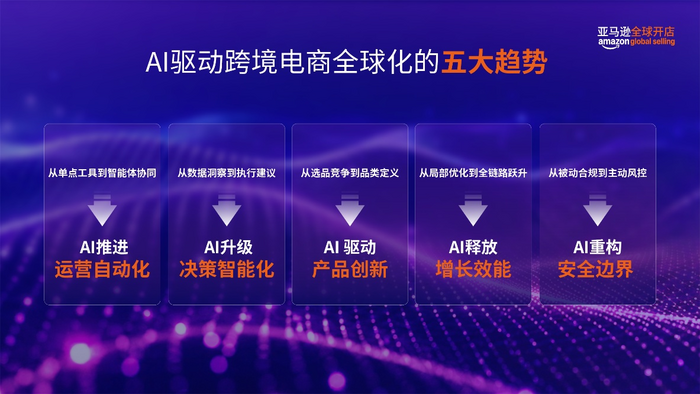
Trend 1: From Point Solutions to Agent Collaboration, AI Drives Operational Automation.
Leading cross-border e-commerce enterprises are evolving their use of AI from point solutions to operational systems featuring agents capable of autonomous reasoning, planning, and action, and even multi-agent interaction and collaboration.
For example, cross-border beauty brand MelodySusie integrated an AI agent with the Amazon Advertising API to build an end-to-end automated advertising agent system. This system not only covers five autonomous capability modules—intelligent cold start, scenario-based targeting, closed-loop optimization, risk control/circuit-breaking, and major promotion campaigns—but also achieves over 90% automation of operational execution. This drove significant revenue growth while maintaining an Advertising Cost of Sales (ACOS) at just one-third of the industry average, with conversion rates increasing by nearly 40%.
Amazon research shows that over 98% of surveyed Chinese sellers already use AI tools when operating their Amazon stores, with 16% having progressed from point AI tools to deploying AI workflows or agents for automated multi-tasking.
Trend 2: From Data Insights to Execution Recommendations, AI Elevates Decision Intelligence.
Faced with complex operational decisions such as pricing, product selection, and restocking, AI is helping sellers transform judgments that previously relied heavily on personal experience or difficult-to-interpret big data piles into quantifiable, verifiable scientific decisions.
Take Amazon Seller Assistant as an example. It can analyze data, predict trends, and provide recommendations across multiple areas including inventory and logistics optimization, account health management, compliance analysis, potential new product insights, and advertising and marketing optimization. With seller permission, it can also execute decisions, while sellers retain control, helping them launch, manage, and grow their business 24/7 like a true assistant. In 2025, Amazon Seller Assistant had over 230,000 monthly active users, and sellers accepted over 90% of its suggested recommendations.
TOPDON, specializing in automotive intelligent diagnostic technology and equipment, established an AI Decision Partner system based on the deep integration of its self-developed big data platform with Amazon Seller Assistant. Using AI-quantified opportunity matrices, TOPDON reduced its new product launch decision response time from days to minutes, with new product sales exceeding ten thousand units within three months of launch.
Trend 3: From Product Competition to Category Definition, AI Drives Product Innovation.
AI is unlocking another possibility for product innovation, shifting from the traditional logic of 'selecting what sells well' to discovering 'unmet needs' and thereby defining and developing new categories. There are three typical paths.
First, using AI to discover hidden gaps in mature categories. LiberNovo used AI to identify unmet needs in the high-end office chair segment, creating a differentiated feature combination of 'bionic backrest + electric adaptive adjustment + active spinal support,' quickly ranking among the top three high-average-order-value products in its category.
Second, integrating AI functionality into products, thereby redefining category capabilities. Global home fitness technology brand Merach pioneered a fitness AI assistant, incorporating tens of millions of exercise samples and an intelligent resistance adjustment system. This transforms equipment from a mere 'fitness tool' into a 'smart coach,' significantly increasing average user training duration.
Third, entirely new consumer product categories native to the AI era. dnsys boostsuit used motion perception and prediction algorithms to create a new consumer-grade smart knee exoskeleton, widely used in daily life, hiking, skiing, cycling, and other scenarios. It has already won three CES Innovation Awards this year.
Trend 4: From Local Optimization to End-to-End Leap, AI Unleashes Growth Efficiency.
The penetration of AI in cross-border e-commerce business chains continues to increase, evolving from the initial stage of local application in areas like listings and advertising towards comprehensive AI deployment across key links such as product selection, content, consumer insights, marketing, compliance, and customer service. This forms an efficiency system with cross-link synergy, improving the quality and efficiency of every operational step.
For instance, gaming peripheral brand GameSir faced the typical conflict between scaling up and resource investment during multi-site expansion. By implementing multiple AI tools in parallel, GameSir doubled the number of sites covered while reducing costs by 40%.
More importantly, end-to-end AI empowerment levels the playing field in operational capability and efficiency, creating possibilities for explosive growth for SMEs and small teams. The Amazon store of lingerie brand ubras is managed by just two people. By fully utilizing Amazon's AI tools to improve personnel efficiency, this two-person team achieved the operational scale of a traditional ten-person team, enabling rapid brand cold start and business growth. Starweave Technology is a typical example of a 'one-person company.' For them, AI is not only an efficiency tool but also the core system for product innovation and business decision-making, having developed a replicable AI-powered product launch workflow that possesses operational capabilities close to those of a full-fledged brand team, from strategy to execution.
Trend 5: From Passive Compliance to Proactive Risk Control, AI Redefines Security Boundaries.
The sustainability of cross-border e-commerce business growth largely depends on a seller's robust and compliant operational capabilities. AI is transforming compliance and risk control from 'remediation after the fact' to 'prevention beforehand': 24/7 automatic monitoring, preemptive risk prediction, and automatic generation of response plans, providing greater security for global operations.
For example, 3D printing equipment brand Creality deeply integrated Amazon's AI account health tools to build a proactive 'predict-warn-handle' account health management system. It can provide early warnings for potential infringement and non-compliant operations, automatically match local regulations across multiple sites to assist with cross-site compliance consistency management, and when violations occur, AI can help analyze the cause and generate preliminary appeal drafts, enabling normalized, fine-grained management of multi-site account health.
[Copyright Notice] Ebrun advocates respecting and protecting intellectual property rights. Without permission, no one is allowed to copy, reproduce, or use the content of this website in any other way. If any copyright issues are found in the articles on this website, please provide copyright questions, identification, proof of copyright, contact information, etc. and send an email to run@ebrun.com. We will communicate and handle it in a timely manner.
Translated by AI. Feedback: run@ebrun.com