
Ninebot Wins Lawsuit! Competitor's Malicious Slander Constitutes Infringement
[Ebrun Original] Ebrun has learned from Ninebot that the company has won a first-instance judgment in a lawsuit against the self-media account "Huangbuhuang Tang_" (hereinafter referred to as the Defendant) for online defamation/unfair competition. The court found that the Defendant, as an agent for the Extreme Core brand, had long produced videos disparaging its competitor, damaging Ninebot's commercial reputation and product reputation, which constituted commercial defamation.
This marks the third successful defamation rights protection case for Ninebot within six months. The company has progressed from testing individual cases to streamlining the process, establishing a complete methodology for rights protection. A relevant person in charge at Ninebot introduced that the team has established a standardized process of "monitoring - identification - evidence preservation - legal assessment - litigation." From the initial exploration in the first case to the efficient progress in the second, the cycle has been significantly shortened.
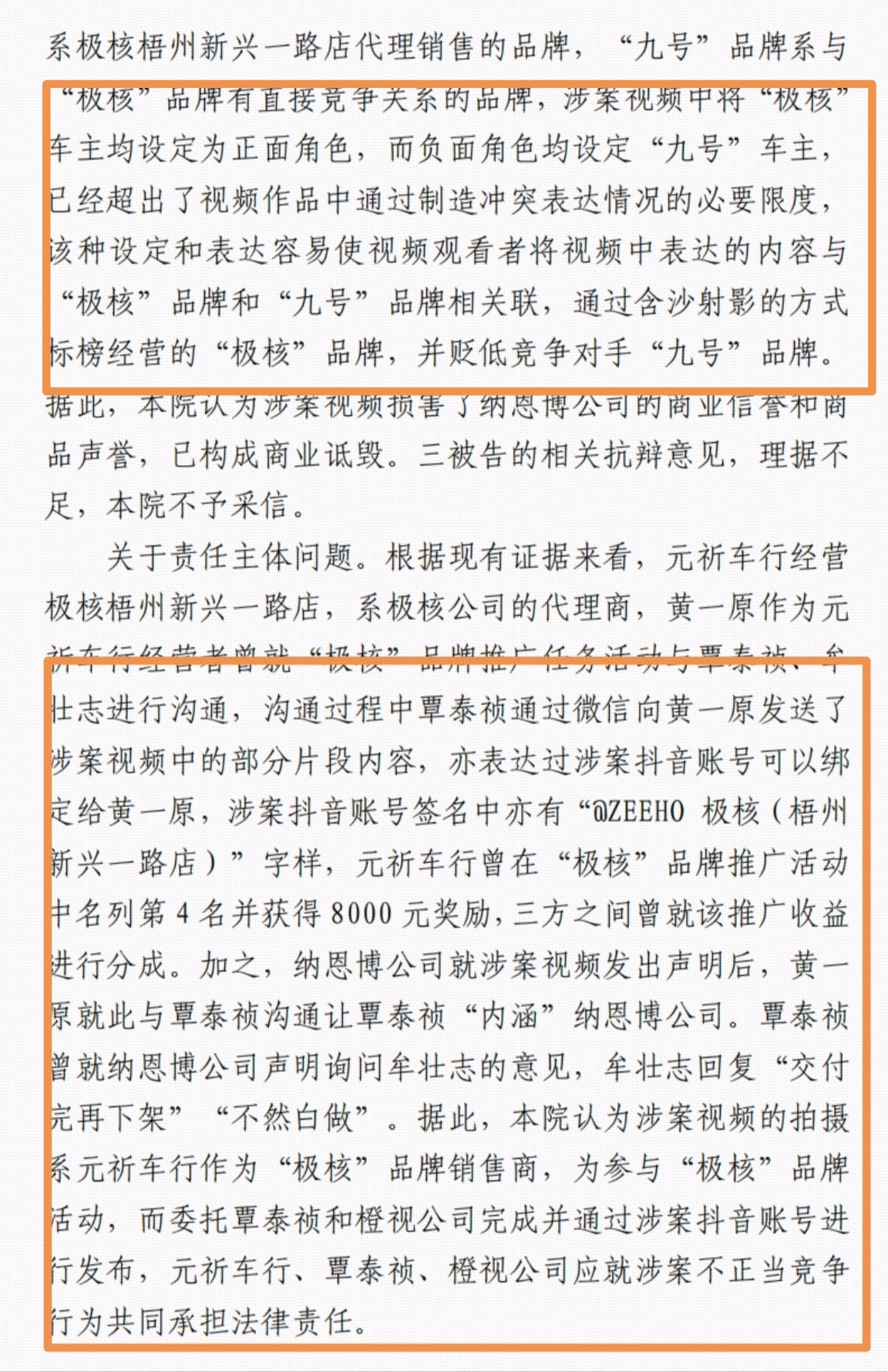
Ninebot (Tianjin) Technology Co., Ltd. is the plaintiff in this case.
"For infringements that fabricate false information, organize malicious review-bombing, or otherwise damage the company's commercial reputation, we will resolutely use legal weapons, investigate thoroughly, and show no leniency," the person in charge stated. They added that organized rumor-spreading networks, batch account farming for comment control, and targeted attacks on competing products are no longer sporadic online disputes but an industrialized, large-scale unfair competition tactic, ultimately creating a "lose-lose" situation for law-abiding businesses and ordinary consumers.
In recent years, regulatory authorities have intensified crackdowns on various chaotic phenomena, such as malicious slander by online "black PR" armies, through measures like the "Clean Cyberspace" and "Clear and Bright" campaigns. The regulators' frequent actions aim to protect three fundamental bottom lines for business development: the right to reputation and commercial goodwill, the right to fair competition, and the right to normal business operations. This is to prevent companies from expending significant resources on public opinion battles rather than product innovation.
Currently, several leading companies are taking a nearly uniform stance of "firmly confronting" online black industries—gathering evidence, filing lawsuits, and refusing settlements. In the first-instance judgment of BYD's lawsuit against "Long Ge Talks Electric Cars," the defendant was ordered to pay 2 million yuan in compensation for repeatedly publishing disparaging and false statements. Associated accounts were also sued separately by Seres and XPeng, with total compensation across the three cases exceeding 2.26 million yuan, serving as a typical example of "multiple strikes against one black PR operation." Huawei, meanwhile, is conducting concentrated evidence collection and batch legal actions across multiple social media platforms.
[Copyright Notice] Ebrun advocates respecting and protecting intellectual property rights. Without permission, no one is allowed to copy, reproduce, or use the content of this website in any other way. If any copyright issues are found in the articles on this website, please provide copyright questions, identification, proof of copyright, contact information, etc. and send an email to run@ebrun.com. We will communicate and handle it in a timely manner.
Translated by AI. Feedback: run@ebrun.com