
EU PPWR Implementation Nears: Will the 'Strictest Packaging Law in History' Trigger a New Wave of Compliance Challenges?
[Ebrun Exclusive] There are less than three months until the formal application of the European Union's Packaging and Packaging Waste Regulation (PPWR).
According to the EU legislative schedule, PPWR will be fully implemented across all 27 EU member states starting August 12, 2026. This regulation, regarded as the most significant reform in EU packaging regulation in nearly three decades, will not only replace the long-standing Packaging and Packaging Waste Directive (94/62/EC) but will also apply directly to the entire EU market as a unified regulation.
For tens of thousands of cross-border e-commerce sellers, brands, platform companies, and logistics service providers operating in the European market, a new wave of compliance transformation centered on packaging design, material usage, labeling, producer responsibility, and recycling systems is accelerating.
Why was PPWR introduced? What are its specific requirements? How will the cross-border e-commerce industry be impacted? How should companies expanding overseas respond to the impending regulatory upgrade? With this series of questions, Ebrun engaged in a dialogue with Li Hengbiao, founder & CEO of cross-border compliance service provider Hengbiao Cross-border and an expert in EU compliance, aiming to provide an in-depth analysis of this upcoming compliance shift.
1. From 'Each Country Governs Itself' to 'Unified Regulation': The Genesis of the EU's New Packaging Law
Looking back, the introduction of PPWR was not accidental.
Using the COVID-19 pandemic as a dividing line, European e-commerce entered a period of accelerated penetration. Correspondingly, the total volume of packaging waste in Europe has continued to rise. Data from the European Commission shows that packaging waste has become one of the fastest-growing waste streams in Europe, with per capita packaging waste generation remaining persistently high.
Meanwhile, because the Packaging and Packaging Waste Directive (PPWD), which came into effect in 1994, is a 'Directive,' each member state needed to transpose it into national law. This has led to a multitude of differentiated requirements in packaging recycling, environmental labeling, and producer responsibility systems in countries like Germany, France, Italy, and Spain.
For cross-border operating enterprises, this meant facing a 'one-country, one-rule' situation when entering the European market, not only increasing compliance costs but also affecting the unity of the EU single market.
Against this backdrop, the EU formally proposed the PPWR legislative draft in November 2022, hoping to establish a unified and directly applicable regulatory framework to promote packaging reduction, recyclability, and circularity, reduce packaging waste generation, and provide institutional support for achieving the goals of the European Green Deal and the circular economy.
After more than two years of legislative debate and industry negotiation, the European Parliament passed the relevant regulation text in 2024. On January 22, 2025, PPWR was officially published in the Official Journal of the European Union and entered into force in February of the same year. After an 18-month transition period, the regulation will officially enter its full implementation phase on August 12, 2026.
From a legislative hierarchy perspective, the most fundamental change of PPWR is its upgrade from a 'Directive' to a 'Regulation,' possessing unified and mandatory legal effect: the previous packaging directive primarily set targets for member states, whereas PPWR applies directly to all EU member states without requiring further transposition into national law—this means future packaging regulatory rules will become more unified, and enforcement standards and regulatory requirements will become more consistent.
In Li Hengbiao's view, this is both a challenge and an opportunity, as it means cross-border enterprises will face a clearer compliance framework in the future.
'The PPWR regulation requires that all producers placing packaged goods on the market of the 27 EU countries must fulfill corresponding compliance obligations. Here, 'producers' includes not only manufacturers but also importers, distributors, retailers, and e-commerce platforms,' he said.
2. From Packaging Materials and Design to Digital Marking: The Countdown to Full Compliance Begins
With less than a year and a half until full implementation, PPWR presents sellers with an extremely stringent and meticulously detailed compliance checklist—so much so that many sellers have dubbed it the 'strictest packaging law in history.'
According to Li Hengbiao, the new compliance system mainly involves seven major categories of requirements.
First, Applicable Entities and Geographic Scope: Defining responsible parties, covered packaging types, applicability across the 27 EU countries, and requiring non-EU sellers to appoint an EU Authorized Representative.
Second, Hazardous Substance Control: Limiting total heavy metal content, strictly controlling PFAS content in food-contact packaging, and prohibiting non-compliant materials.
Third, Packaging Design and Reduction Standards: Prohibiting excessive packaging, limiting void space in e-commerce packaging, and restricting or banning certain single-use packaging categories.
Fourth, Recyclability and Recycled Content Targets: Classifying packaging recyclability levels with phased compliance requirements; mandating a corresponding proportion of recycled content in plastic packaging.
Fifth, Packaging Marking and Traceability Requirements: Standardizing material codes and recycling symbols; requiring EPR registration numbers and EU representative information; later adding product traceability codes and digitizing compliance information.
Sixth, EPR (Extended Producer Responsibility) System: Requiring separate registration per sales country; annual declaration and payment of recycling/disposal fees based on packaging weight; platform verification of qualifications.
Seventh, Compliance Deadlines and Penalties for Non-compliance: Phased implementation of various clauses; non-compliance risks include product delisting, customs detention, and high fines based on a percentage of turnover;
Among these new rules, the most direct impact on e-commerce sellers may be the mandatory limit on packaging void space.
PPWR stipulates that from its effective date, the empty space within all e-commerce parcels must not exceed 40%. The past practice of using oversized boxes with excessive bubble fillers to protect goods—'big boxes for small items'—will directly face non-compliance risks. Packaging must achieve weight and volume minimization, and superfluous designs like double walls or false bottoms that add unnecessary bulk will be explicitly prohibited.
A more profound impact comes from the quantified grading system for packaging recyclability.
PPWR introduces, for the first time, three grades—A, B, and C—requiring recyclability rates of 95%, 80%, and over 70%, respectively. By 2030, all packaging must reach at least Grade C and advance to Grade B by 2038.
This grading system will directly phase out a large number of non-recyclable or hard-to-recycle composite material packages currently on the market. For example, common packaging forms like kraft paper bags with plastic windows or multi-layer composite films will face potential bans after 2030. 'This will force sellers to transition in advance towards 'single-material' eco-friendly packaging solutions.'
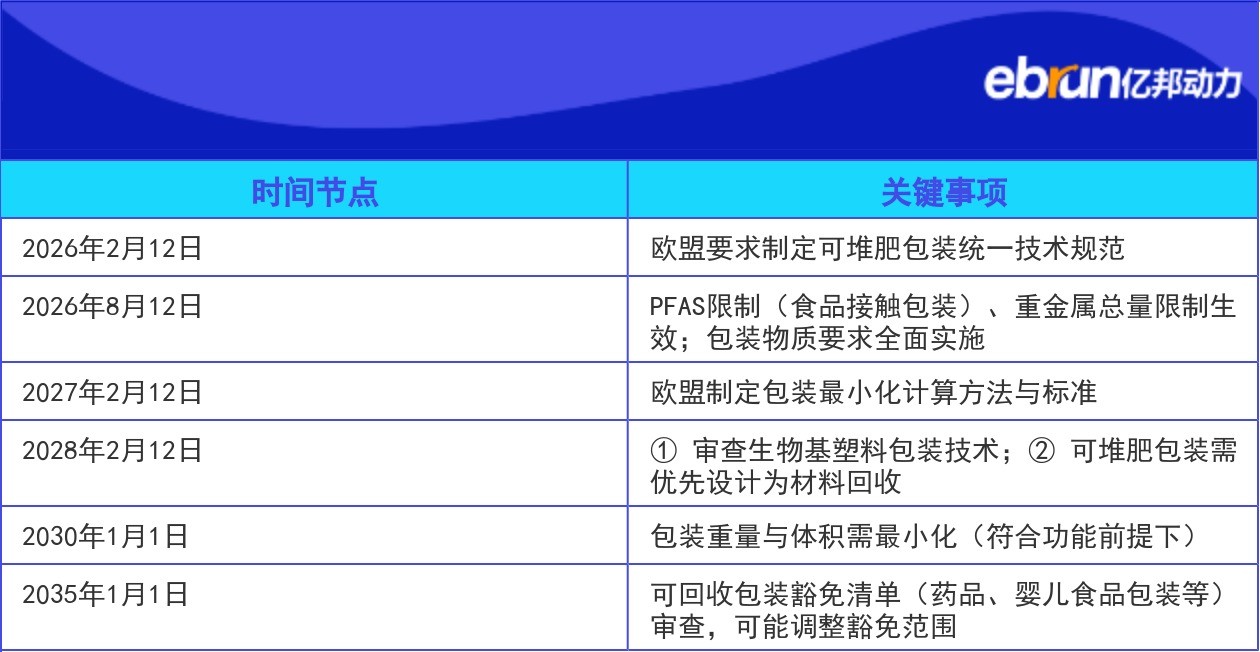
According to the timeline disclosed by the EU, companies expanding overseas will face a continuous 'countdown' to compliance in the coming years.
| Key Milestones | Key Matters |
| February 12, 2026 | EU to establish unified technical specifications for compostable packaging |
| August 12, 2026 | PFAS restrictions (for food-contact packaging) and total heavy metal limits take effect; packaging substance requirements fully implemented |
| February 12, 2027 | EU to establish calculation methods and standards for packaging minimization |
| February 12, 2028 | ① Review bio-based plastic packaging technology; ② Compostable packaging must be designed for material recycling as a priority |
| January 1, 2030 | Packaging weight and volume must be minimized (subject to functional requirements) |
| January 1, 2035 | Review of exemptions list for recyclable packaging (e.g., for pharmaceuticals, baby food packaging), with possible adjustments to exemption scope |
3. Sellers at the Eye of the Compliance Storm: Cost Structures and Operational Models Face Reshaping
'PPWR is not a short-term rectification but a systematic 'green revolution' for cross-border e-commerce packaging in Europe,' Li Hengbiao pointed out. 'In the future, with higher entry barriers, increased costs, packaging redesign, stricter platform oversight, and severe penalties for non-compliance, green compliance will become the core competitiveness for sellers operating in the European market.'
In fact, in his view, this regulation is actually pushing the entire industry towards a transformation focused on 'environmental friendliness, single materials, and recyclability.'
'In the past, many sellers focused more on the protective function of packaging during transportation, but from now on, the packaging itself will become a regulated object; easy recyclability, biodegradability, and single materials will become the mainstream direction for future packaging design,' one seller told Ebrun.
'On the other hand, as the void space standards become stricter, how to improve the protective performance of outer packaging for products within limited materials and volume is also a question worth considering,' he added. 'A possible solution I can think of is introducing shells with higher structural strength or even directly adjusting the product form itself.'
Notably, PPWR is not solely targeting sellers; its impact is extending throughout the entire cross-border ecosystem.
Li Hengbiao believes that platform companies will become key responsible entities in this round of regulatory upgrade.
'PPWR explicitly includes online marketplaces within the responsibility system. When platforms handle packaging or logistics on behalf of third-party sellers, they also need to bear corresponding responsibilities,' he said. 'In the future, platforms will not only audit EPR compliance status but will also further scrutinize whether packaging materials, packaging structure, and labeling meet the requirements.'
In this regard, this means mainstream platforms like Amazon, eBay, Temu, and TikTok Shop may further strengthen their packaging review mechanisms in the future, with non-compliant products facing risks of delisting, suspension of sales, or even restrictions on warehousing.
For sellers, a more direct challenge comes from cost and operational pressures.
Li Hengbiao stated that after PPWR implementation, sellers' compliance costs will see a significant increase.
'In the past, sellers might only need to pay attention to packaging regulations in a few countries, but in the future, the compliance scope expands to the entire EU market. Costs for EPR registration, packaging testing, material upgrades, and label modifications will all increase, with total investment potentially rising from a few thousand yuan to tens of thousands or even more.'
Simultaneously, because EPR accounts are not transferable between different countries, compliance registration cycles are inconsistent, and enforcement rhythms also vary, sellers will need to invest more time in market planning and compliance layout. Li Hengbiao admitted that against the backdrop of sharply increased compliance pressure, some markets with limited sales scale and low order volume might even be proactively abandoned by some sellers in the future.
Besides rising costs, inventory and capital risks have also become a focus of industry attention.
Li Hengbiao pointed out that after PPWR implementation, any problem in any link could trigger a 'domino effect' of chain reactions: 'Customs inspections, platform spot checks, market supervision random checks—as long as packaging is found non-compliant, it could lead to product detention, inventory freezing, or even fines.'
In fact, one unique aspect of PPWR itself is: it stipulates what companies must comply with, but the specific amount of fines and how penalties are imposed are not uniformly regulated by the EU; they are delegated to each member state to formulate.
Currently, non-compliant enterprises may face consequences beyond customs detention, product delisting, restricted market access, or mandatory recalls, and may also be subject to administrative penalties linked to their turnover.
'Faced with complex new regulations, sellers need to conduct self-audits in advance, make rapid corrections, and even seek help from professional service providers to conduct a round of 'packaging risk assessment,' eliminating non-compliant factors ahead of time,' Li Hengbiao pointed out.
Ebrun will continue to track and report on this development. To learn more about information related to this article, please scan the QR code to follow the author's WeChat.

[Copyright Notice] Ebrun advocates respecting and protecting intellectual property rights. Without permission, no one is allowed to copy, reproduce, or use the content of this website in any other way. If any copyright issues are found in the articles on this website, please provide copyright questions, identification, proof of copyright, contact information, etc. and send an email to run@ebrun.com. We will communicate and handle it in a timely manner.
Translated by AI. Feedback: run@ebrun.com