
Cross-Border Seller ZIEL Home Furnishing Reports 2025 Revenue Exceeding 8.7 Billion Yuan: Europe Remains Core Market, Amazon Vendor Central Business Soars
Ebrun Original: Recently, cross-border e-commerce company ZIEL Home Furnishing Technology released its financial reports for 2025 and the first quarter of 2026. The reports show that in 2025, ZIEL's revenue reached 8.701 billion yuan, a year-on-year increase of 7.1%; non-GAAP net profit attributable to the parent company was 319 million yuan, a year-on-year increase of 3.43%. In the first quarter of 2026, ZIEL's revenue was 2.314 billion yuan, a year-on-year increase of 10.66%; non-GAAP net profit attributable to the parent company was 57.48 million yuan, a year-on-year decrease of 52.04%.
ZIEL Home Furnishing Technology is primarily engaged in the R&D, design, and sales of self-owned brand furniture and home furnishing products, with brands including the home furnishing brand SONGMICS, the style furniture brand VASAGL, and the pet home brand Feandrea. During the reporting period, the company primarily sells products to end consumers across Europe, the US/Canada, and Latin America through overseas online retail platforms such as Amazon, OTTO, and its own direct-to-consumer (DTC) websites, covering business processes from product R&D and design, outsourced production and procurement, cross-border transportation and warehousing, to online sales and customer service.
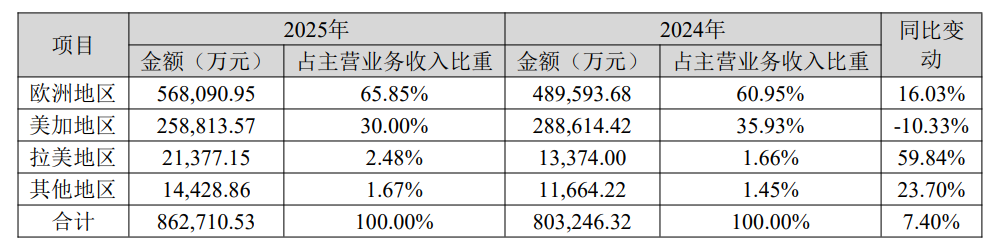
Looking at 2025, ZIEL's largest market remains Europe, accounting for 65.85% of its main business revenue; the second largest market is the US/Canada region, accounting for 30%; the Latin American business is developing rapidly, but currently only accounts for 2.48%. Specifically: In 2025, ZIEL's revenue in Europe was 5.681 billion yuan, a year-on-year increase of 16.03%; revenue in the US/Canada was 2.588 billion yuan, a year-on-year decrease of 10.33%; revenue in Latin America was 214 million yuan, a significant year-on-year increase of 59.85%; revenue in other regions was 144 million yuan, a year-on-year increase of 23.7%.
By product line, in 2025, ZIEL's furniture series revenue was 4.687 billion yuan, a year-on-year increase of 11.65%; the home furnishing series revenue was 3.072 billion yuan, a year-on-year increase of 4.01%; the pet series revenue was 615 million yuan, a year-on-year decrease of 9.01%; the sports & outdoors series revenue was 254 million yuan, a year-on-year increase of 23.64%.
By sales channel, in 2025, ZIEL's online B2C business contributed 77.25% of revenue, online B2B contributed 17.23%, and offline B2B contributed 5.52%. Within the online B2C business, revenue from Amazon was 4.673 billion yuan, a year-on-year decrease of 13%; revenue from OTTO was 393 million yuan, a year-on-year increase of 12.05%, making it the second-largest B2C sales channel; revenue from its DTC websites was 238 million yuan, a year-on-year increase of 11.3%. Within the online B2B business, revenue from Amazon Vendor Central (VC) was 1.308 billion yuan, a significant year-on-year increase of 131.44%.
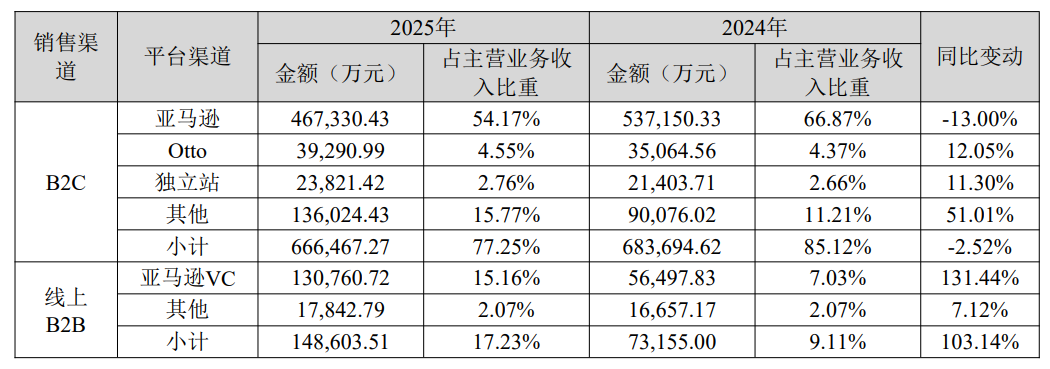
ZIEL pointed out in its financial report that during the reporting period, the company continued to optimize its channel structure and deepen its cooperation model with Amazon. Building on its competitive advantages in the B2C model, it accelerated its shift towards the B2B model. Simultaneously, the company continued to advance its multi-platform strategy, with OTTO and its DTC websites maintaining steady growth, and emerging platforms like Shein accelerating volume growth.
Facing a complex and volatile international trade environment and rising cost pressures, ZIEL focused on three major strategic adjustments in 2025 to mitigate risks:
1. Supply Chain Restructuring:
In response to significant fluctuations in US tariff policies and a sharp increase in compliance costs at the beginning of 2025, ZIEL implemented a strategic supply chain shift, relocating the supply chain for products bound for the US to Southeast Asia. Although it experienced temporary pains in capacity transition and inventory tightness in the short term, it rapidly accelerated sourcing, production line setup, and quality improvement in Southeast Asia. By the fourth quarter of 2025, the Southeast Asian supply chain had achieved stable delivery, capable of meeting 80% of the US market's shipment demand.
Concurrently, by deepening cooperation with core suppliers and optimizing trade terms, ZIEL successfully established a dual-capacity backup and flexible allocation system of "China N," alleviating unilateral tariff risks and significantly enhancing the supply chain's resilience.
2. Sales Model Diversification:
In 2025, ZIEL vigorously expanded its Amazon Vendor Central (VC) channel business under the B2B model. The proportion of VC business to main business revenue increased from 10.16% in Q1 to 24.88% in Q4. Proactively deepening the VC channel layout aims to leverage its massive business scale and well-established overseas warehousing and logistics system into channel bargaining power. Compared to traditional models, the VC model, through bulk purchasing, centralized supply, and deep partnerships, not only secured more platform traffic support and stable order forecasts but also effectively diluted various comprehensive operating expenses and optimized overall profit levels.
3. AI and Data Intelligence-Driven Operations:
In 2025, ZIEL firmly advanced its "AI " strategy, deeply integrating artificial intelligence technology into its core business processes. In terms of technology and organizational foundation, it successfully established an integrated management system combining "AI, RPA, and Agile Development." It independently developed the "ZIEL Lingchuang" platform, which integrates multimodal large language models and AI coding capabilities in a one-stop manner, constructing a system architecture of "General Agent → Business-Specific Agent → Full-Scene Application." Simultaneously, leveraging intelligent agent platforms like ByteDance's, it broke the limitations of traditional IT dominance and vigorously promoted a company-wide innovation ecosystem where "everyone uses AI and creates AI." It has now developed and deployed over 80 intelligent agents, deeply covering all business areas including product R&D, supply chain management, marketing and sales, financial accounting, IT software development, and data analysis.
It is reported that ZIEL has currently achieved large-scale implementation and value conversion of AI in the "production, supply, and sales" chain:
In R&D and product development, using the "Intelligent Insight System," AI deeply analyzes market trends and end-user needs, accurately assisting in product selection and R&D decisions; in the supply chain, AI technology is deeply embedded in fulfillment and quality inspection, effectively optimizing compliance and control precision; AI is used to automatically generate HS codes, optimizing cross-border logistics customs clearance and compliance systems; AI visual recognition technology is also introduced to efficiently inspect quality control images, significantly improving the accuracy and efficiency of quality control for batch products.
Furthermore, ZIEL actively promotes end-to-end AI in marketing. In content creation, it upgraded the AIGC 2.0 intelligent image library platform, integrating multimodal large models to achieve batch automated image generation, producing high-quality product images and reducing manual photography costs; it achieved automated generation of e-commerce copy, improving efficiency by 70% in a single process and significantly shortening new product launch cycles. In marketing campaigns, it achieved automated management of ad bidding and placement, effectively enhancing advertising efficiency and ROAS; in after-sales service, an AI email response system was deployed, with 30% of responses now handled automatically by AI, improving copy processing efficiency by over 30% and significantly enhancing response speed and service quality.
Regarding future development plans, ZIEL stated that in the US market, facing challenges, the company will contract its focus, deepen its efforts in top-tier categories, and drive profitability recovery; in the European market, it will adopt an aggressive expansion strategy to increase market share, deepen platform ecosystem capabilities, and consolidate competitive advantages; in Latin America, it will replicate the advantages from mature markets to create a new growth engine. Additionally, the company will continue to enhance organizational efficiency through comprehensive AI empowerment.
[Copyright Notice] Ebrun advocates respecting and protecting intellectual property rights. Without permission, no one is allowed to copy, reproduce, or use the content of this website in any other way. If any copyright issues are found in the articles on this website, please provide copyright questions, identification, proof of copyright, contact information, etc. and send an email to run@ebrun.com. We will communicate and handle it in a timely manner.
Translated by AI. Feedback: run@ebrun.com