
AI-Powered Full-Funnel Marketing: How Amazon Ads Help Chinese Brands Tell Global Stories?
【Ebrun Original】Recently, Amazon Ads' annual flagship summit, unBoxed, was held in Shenzhen. At the event, Amazon Ads interpreted the development trends of the global marketing industry and shared multiple innovative advertising products, as well as how deep integration of technology, creativity, and media helps Chinese brands achieve high-quality overseas expansion.
First is the continuous expansion of the global entertainment content and media landscape, accelerating the conversion from entertainment scenarios to business.
According to the introduction, Amazon's streaming service Prime Video continues to invest in popular films, TV shows, and live sports events, with monthly ad-supported users worldwide now exceeding 315 million; Prime Video ads are already live in 16 countries and regions and will expand to Belgium, Denmark, Norway, and Turkey by 2026. Amazon's interactive community, Twitch, recorded billions of hours of total watch time in 2025, covering areas like gaming, music, and sports. Furthermore, Amazon collaborates with premium third-party publishers like Roku, Disney, and Netflix to continuously expand its global premium ad inventory.
Through Amazon DSP, advertisers can leverage Amazon's entertainment assets like Prime Video, Twitch, and Fire TV, as well as third-party publishers like Netflix, Disney, and Spotify, to reach more relevant consumers. Relying on Amazon's trillions of signals generated from browsing, shopping, and streaming, they can gain deeper insights into their target audience and optimize omnichannel marketing strategies.
Second is the full-process innovative AI solutions, making overseas marketing more cost-effective and efficient.
The transformation AI brings to the marketing industry is no longer limited to single-point scenarios like creative generation, copywriting, and data analysis but has entered a new stage of full-domain penetration and deep restructuring. At the summit, Amazon Ads also showcased a series of AI-driven innovative tools and products. For example:
1. Ads Agent. It allows advertisers to manage hundreds of campaigns across accounts in bulk using natural language, completing tasks that previously took hours manually in minutes. It also provides intelligently recommended audience segments and keywords, and shortens the time to gain insights from Amazon Marketing Cloud.
2. Creative Agent. It enables advertisers to achieve full-process creation from concept ideation, scriptwriting, image generation, animation production to voice-over and music scoring through conversation, producing professional-quality ads within hours at no extra cost.
3. AI-powered Sponsored Products prompts and Sponsored Brands prompts. These appear in the dialog of Amazon's AI shopping assistant Rufus, as well as in search results, product detail pages, and existing ad placements on Amazon's website. They can automatically generate responses based on the advertiser's product detail pages, brand stores, and ad keywords, recommending relevant products to customers, helping consumers make purchase decisions, and driving sales conversions.
4. AI-powered Campaign Manager. It allows advertisers to receive intelligent optimization suggestions and act on them in real-time, and they can get assistance from Ads Agent through conversation at any time. Previously, advertisers needed to manage search ad and programmatic ad buying separately through Amazon Ads Console and Amazon DSP. The new Campaign Manager integrates both platforms, providing advertisers with a unified entry point for ad delivery and management, simplifying operations, saving time, and improving efficiency. Moreover, a unified reporting center provides campaign insights across ad products, making ad performance optimization and measurement simpler and more convenient.
Third is the continuous innovation of search ad products, simplifying global advertising operations and brand building.
Addressing the needs of Chinese cross-border brands operating across multiple marketplaces, Amazon Ads launched "Sponsored Products Global Campaigns" at the summit. This allows advertisers to seamlessly launch and manage Sponsored Products campaigns in multiple countries/regions and enhance marketing effectiveness through AI-driven campaign setup. This feature is not simply replicating the same campaign across different sites; instead, it uses large AI models to analyze local cultural nuances and consumption trends to build differentiated campaigns.
Simultaneously, Amazon Ads also introduced "Sponsored Products video." This new ad format integrates long-form videos into Sponsored Products campaigns, helping consumers understand product information more deeply. Advertisers can more intuitively showcase the actual use effect of products and provide flexible, personalized experiences. Shoppers can watch the full video or use interactive thumbnails to jump to specific segments.
"Sponsored Brands collections" enable advertisers to plan and display a series of related products in a single ad. Consumers don't need to perform multiple searches; they can easily click to browse different styles, compare colors, and view features simultaneously. For advertisers, AI dynamically selects more relevant product combinations based on consumer needs, improving conversion efficiency without the need to repeatedly create multiple campaigns.
Additionally, it is worth mentioning that at this summit, Tamir Bar-Haim, Global Vice President of Marketing at Amazon Ads; Wayne Purboo, Global Vice President of Shopping Video at Amazon; and Yang Tong, Vice President of Amazon China and Head of Large Customer Expansion for Amazon Ads in China and South Korea, jointly attended a media briefing. They provided detailed answers on topics such as "How Amazon Ads maintains competitiveness in the AI era," "How Amazon responds to the impact of the video/live shopping trend," and "How Chinese cross-border sellers can better utilize Amazon Ads for brand upgrade."
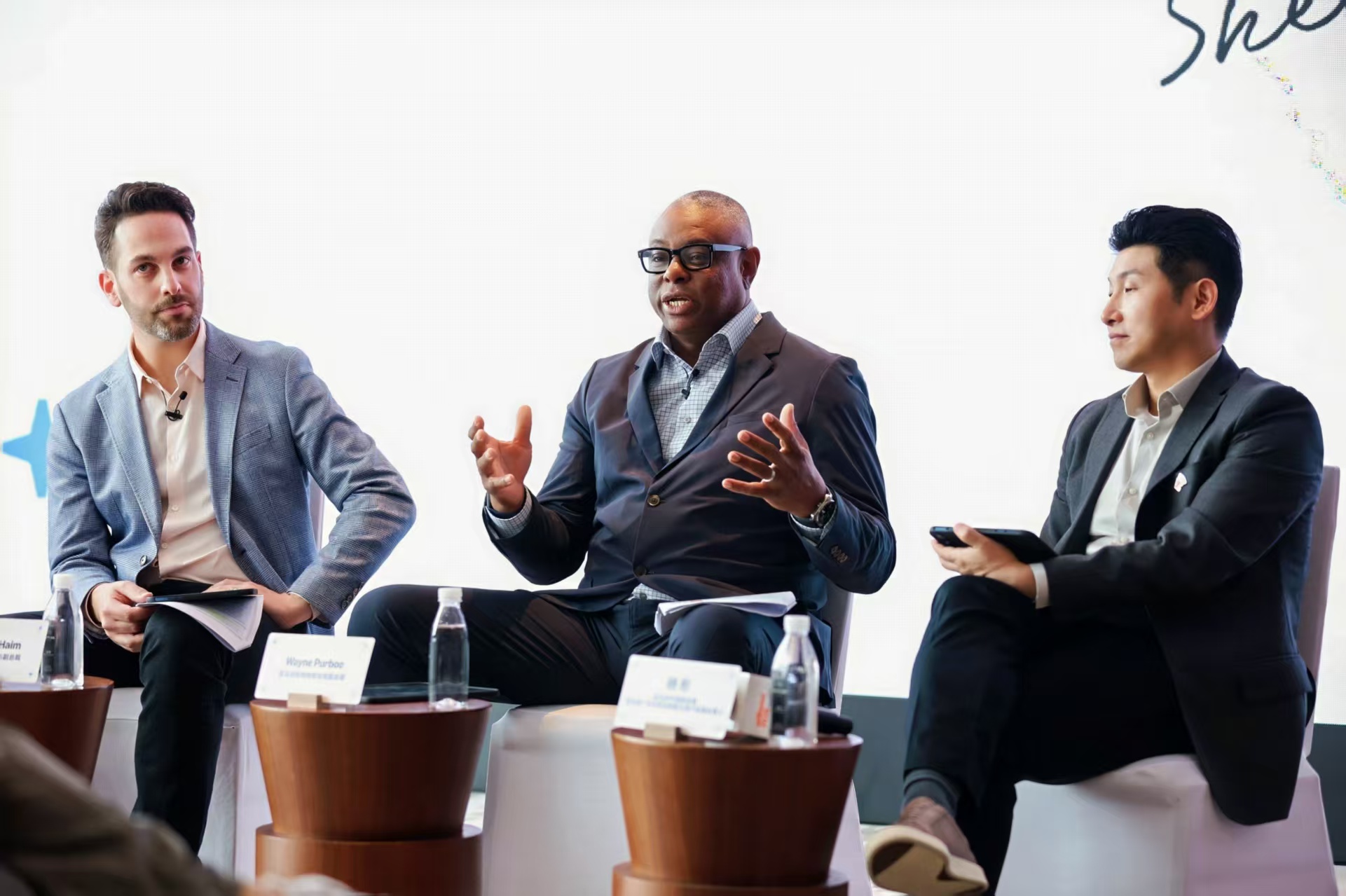
Ebrun has summarized the key points from the media briefing as follows:
Q: Google, Meta, and TikTok are all vigorously promoting AI-driven advertising products. Amazon Ads also has many AI capability updates this year. Comparatively, what is your differentiated advantage?
Tamir: The unique aspect of Amazon Ads lies in its extensive global reach, including trillions of first-party shopping and entertainment signals from Amazon, as well as advanced technologies like Amazon Marketing Cloud, which help marketers drive measurable, full-funnel business outcomes at scale.
Our investments in AI aim to simplify how brands leverage these technologies. For example, in China, most brands we work with are still founder-led companies. They are fast-growing businesses, and the founders often wear multiple hats. While they are committed to making effective marketing decisions and reaching new customers, they also face numerous other operational demands to sustain business growth. Our AI investments aim to empower these founders and their marketing teams by saving them more time through increased efficiency, supporting them in functions like video generation, campaign management, data insights, and full-funnel campaign execution.
Yang Tong: We also hope these AI tools not only improve productivity and efficiency but, more importantly, enhance the value of cross-border brands. That is, to help brands better "seed" interest among the vast global consumer base and become beloved brands, truly achieving the integration of brand building and performance. For instance, how to accurately reach local consumers in different global markets? The media usage habits of consumers in each market are different. Amazon Ads' AI creative capabilities can assist brands in bringing their innovations to consumers in a better, more fitting manner.
More importantly, our AI tools are built on a foundation of trillions of consumer insights. Their value lies not only in better helping advertisers and brands with execution but also in helping them deepen their strategic thinking and breadth, enabling strategic thinking and planning at the global operations level.
Q: AI is changing the traditional model of consumer search and shopping (e.g., shifting to AI conversation interfaces like ChatGPT, Gemini for shopping recommendations). What impact will such changes have on Amazon's advertising business?
Tamir: AI will fundamentally change how consumers browse and buy products, but we are not threatened or worried by this; instead, we are deeply inspired. For decades since Amazon's founding, consumer adoption of new technologies has always driven us to develop new features to serve them better.
When we think about what consumers seek when shopping on Amazon, we find convenience is one of the most critical elements. They want to make purchase decisions efficiently and then get on with their busy work and lives. AI presents a unique opportunity for us to create value for our customers in this regard.
For example, our shopping assistant Rufus currently serves over 300 million active consumers. We've found that consumers who use Rufus are 60% more likely to complete a purchase during their shopping journey compared to those who don't use the tool. Rufus has already demonstrated its utility in providing convenience to customers, whether handling simple tasks like "help me choose from these three competing products" or setting price alerts, such as "alert me when this product's price drops below a certain level so I can buy it."
We already serve ads within Rufus. We are excited to find new ways to showcase brands. As long as we can do this in a highly relevant manner, we believe it will add value to our customers' shopping and entertainment experiences.
Q: We see that live shopping is becoming a new trend. Amazon is also doing live shopping. How is it different from TikTok Live, and what is the specific progress?
Wayne: First, I want to emphasize that we do not view Amazon Live as a direct competitor to TikTok. Customers come to Amazon to shop, or rather, there is a fundamental difference in mindset when a user opens the Amazon app versus the TikTok app. We have been working to leverage a vast number of consumer insight signals to define the ideal live shopping experience on Amazon, creating a model distinctly different from the social media experience.
Surveys show that 72% of online shoppers trust Amazon more than most other shopping platforms. Therefore, we build the live shopping experience on this foundation of trust and authentic perspective. In stark contrast to the fleeting "swipe" culture, we are committed to providing highly precise content, ensuring audiences see the live streams they are interested in. We observe that the result is significantly higher click-through and conversion rates compared to the average on social media apps.
We are very satisfied with the current progress and will continue to invest in optimizing the Amazon Live shopping experience. Last year, Amazon Live began its global rollout, expanding to Canada, the EU5 (the five largest economies in Europe), and Japan, with plans to continue expanding coverage.
Q: What are the similarities and differences between Amazon Live shopping and the live shopping format in China? Do Chinese brands need to switch their mindset when doing live shopping for overseas markets?
Wayne: One of the biggest differences I've observed is that video shopping in China is highly conversion-centric, heavily focused on the bottom of the marketing funnel. Every video is a "hard sell," constantly urging "buy, buy, buy." But in North America and other parts of the world, while there are some hard-sell videos, there is more educational or brand-building content.
One thing Chinese brands need to understand is that in other parts of the world, brand matters. For example, brands like Apple and IBM are worth tens of billions of dollars themselves, backed by possibly tens of billions invested in telling their brand stories. And we see very long attribution windows; customers might buy a product six months after watching a live stream. Therefore, much of the content you see in our videos and live streams is not always about pushing sales but more about communicating product value. Moreover, on Amazon Live, you'll see that the brand objectives for each live stream are diverse.
This is also something we are actively working on with Chinese sellers and brands—helping them understand how to build a brand.
Yang Tong: In China, live streaming and short videos have been developing in the entertainment industry for a long time, so the audience is already very accustomed to receiving information through short videos and live streams. The entertainment scenario has gradually evolved into a transaction and shopping scenario.
Overseas, we observe that consumer usage habits have more distinct scenario-based boundaries—work scenarios, life scenarios, entertainment scenarios, and consumption scenarios are more clearly separated. So, when designing the live shopping product, Amazon also bases it on the usage habits of overseas users, and we consider more about how Amazon Live can enrich Amazon's existing service environment.
We certainly also focus on helping brands and sellers facilitate transactions better, but we also hope to provide consumers with a complete experience, not just stopping at adding items to the cart and purchasing, but also including how the product is delivered, customer service, etc. Therefore, in our strategy, Amazon Live is part of Amazon's "shopping ecosystem," an integral part of the overall consumer experience. It relies on the entire marketplace and the services behind it.
Q: How does Amazon Ads help brands achieve multi-marketplace global marketing?
Tamir: Currently, our advertising business spans over 40 countries and regions worldwide. One of our important goals is to help the brands we work with diversify their business and reach global consumers.
We find that many cross-border brands, especially over the past 12-18 months, are actively seeking opportunities to expand into new markets. They know advertising is a very effective way to increase visibility and quickly launch business in new markets. The long-standing challenge for these brands, especially startups, has been limited time, making it difficult for them to expand to more markets. We have made this a top priority. We want to provide these brands with the most efficient global advertising service possible, without requiring a disproportionate amount of additional time for each new region.
Many of our AI tools, such as Ads Agent and Creative Agent, are designed to help advertisers understand local nuances more deeply and localize creative campaigns for new markets. We have also integrated other important global advertising features into DSP and Sponsored Products ads, which make it easier for cross-border advertisers to set up a campaign once and run it across all marketplaces.
[Copyright Notice] Ebrun advocates respecting and protecting intellectual property rights. Without permission, no one is allowed to copy, reproduce, or use the content of this website in any other way. If any copyright issues are found in the articles on this website, please provide copyright questions, identification, proof of copyright, contact information, etc. and send an email to run@ebrun.com. We will communicate and handle it in a timely manner.
Translated by AI. Feedback: run@ebrun.com