
Amazon's First Global Smart Hub Warehouse in Shenzhen Officially Opens, Reducing Seller Storage Costs by Up to 45%
[Ebrun Original] Recently, Amazon's first global smart hub warehouse (Global Warehousing and Distribution, GWD) in Shenzhen has been fully opened to sellers. The facility currently supports shipments to Amazon's U.S. fulfillment centers. Amazon also stated that GWD will expand to the Yangtze River Delta region in the future and will support shipments to fulfillment centers in Europe and Japan.
This is not just about building another warehouse. GWD is an integrated global warehousing and distribution service established by Amazon at the source of goods, covering storage, customs clearance, cross-border transportation, and inventory allocation, seamlessly connecting with Amazon's global FBA (Fulfillment by Amazon) network. Sellers only need to ship their goods to the Shenzhen GWD, and Amazon handles the rest, creating a logistics channel that goes "from local warehouses directly to global customers."
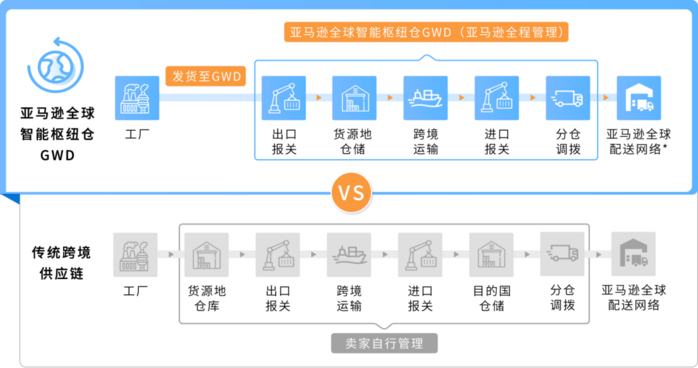
In the past, under the "one shipment, one destination" rule, cross-border sellers' global expansion often came with high trial-and-error costs and complex operational challenges. If sellers wanted to enter new markets or test new products, they had to ship a certain volume of inventory to overseas warehouses in the target country in advance. This tied up significant working capital overseas, and if market response fell short of expectations, it not only increased the risk of unsold inventory but also led to cost losses. Additionally, the cross-border logistics chain is long, involving first-leg transportation, export customs clearance, destination port clearance, and last-mile delivery, often requiring coordination with multiple service providers and complex management processes.
GWD aims to change this. By establishing warehouses at the source as smart hubs, it will gradually enable the use of a unified inventory pool to schedule and match demand across different marketplaces, supporting "small-batch, high-frequency" shipments and allowing cross-border merchants to shift from "heavy inventory bets" to "lightweight investments."
A core capability supporting this system is Amazon's proprietary cross-border logistics service, AGL (Amazon Global Logistics). With over 400 cross-border shipping routes across more than 10 ports in China, AGL provides dedicated shipping capacity for GWD, helping sellers forecast cargo volume in advance, secure space, and ensure supply chain stability.
Cost savings and convenience are the most immediate attractions of this model. According to Amazon data, compared to local U.S. storage (Amazon Smart Satellite Warehouses), using GWD can reduce sellers' storage costs by up to 45%, with savings mainly coming from the difference in warehouse rental costs between China and the U.S. Furthermore, complex cross-border processes are integrated into a one-stop service, enabling one-time inbound customs declaration and batch outbound shipments, greatly simplifying operations.
It is worth noting that by the end of 2025, Amazon Global Selling officially proposed the "Next-Generation Cross-Border Chain," with the vision that cross-border e-commerce businesses only need to list products once on Amazon and ship inventory once to a warehouse at the source to achieve global sales. As part of this overall solution, the official opening of GWD signifies the gradual implementation of the "Next-Generation Cross-Border Chain" strategy.
[Copyright Notice] Ebrun advocates respecting and protecting intellectual property rights. Without permission, no one is allowed to copy, reproduce, or use the content of this website in any other way. If any copyright issues are found in the articles on this website, please provide copyright questions, identification, proof of copyright, contact information, etc. and send an email to run@ebrun.com. We will communicate and handle it in a timely manner.
Translated by AI. Feedback: run@ebrun.com