
Shopify Bets on Agentic Commerce: Enabling Independent Store Merchants to Seize AI's New Traffic Dividend First
[Ebrun Exclusive] "The question Agentic Commerce aims to answer is: When consumers no longer open search engines but directly ask AI about their purchasing needs, can brands appear in the conversation?" In the recent "Shopify Editions Winter '26 Official Interpretation Live Stream," Yan Liang, Senior Solutions Engineer for Key Accounts at Shopify, summarized in one sentence what Shopify's advancing Agentic Commerce seeks to solve.
A fact is, over the past 10-20 years, the fundamental model of online shopping has hardly changed: search keywords → browse and compare prices → click to view → purchase. The entire process is actively operated by consumers. However, AI is now rewriting this paradigm—consumers ask AI questions, and AI can not only help search but also understand their intent and directly recommend products, finally allowing consumers to place orders without leaving the conversation interface.
According to reports, from Shopify's global business perspective, since January 2025, AI search has driven a 15-fold increase in orders, an 8-fold increase in traffic to merchant stores, and the number of stores receiving AI search traffic has doubled.
To help independent store merchants seize the new AI traffic dividend first, Shopify has built an Agentic Storefront for merchants and completed integration with all major AI platforms, forming a complete Agentic Commerce closed loop.
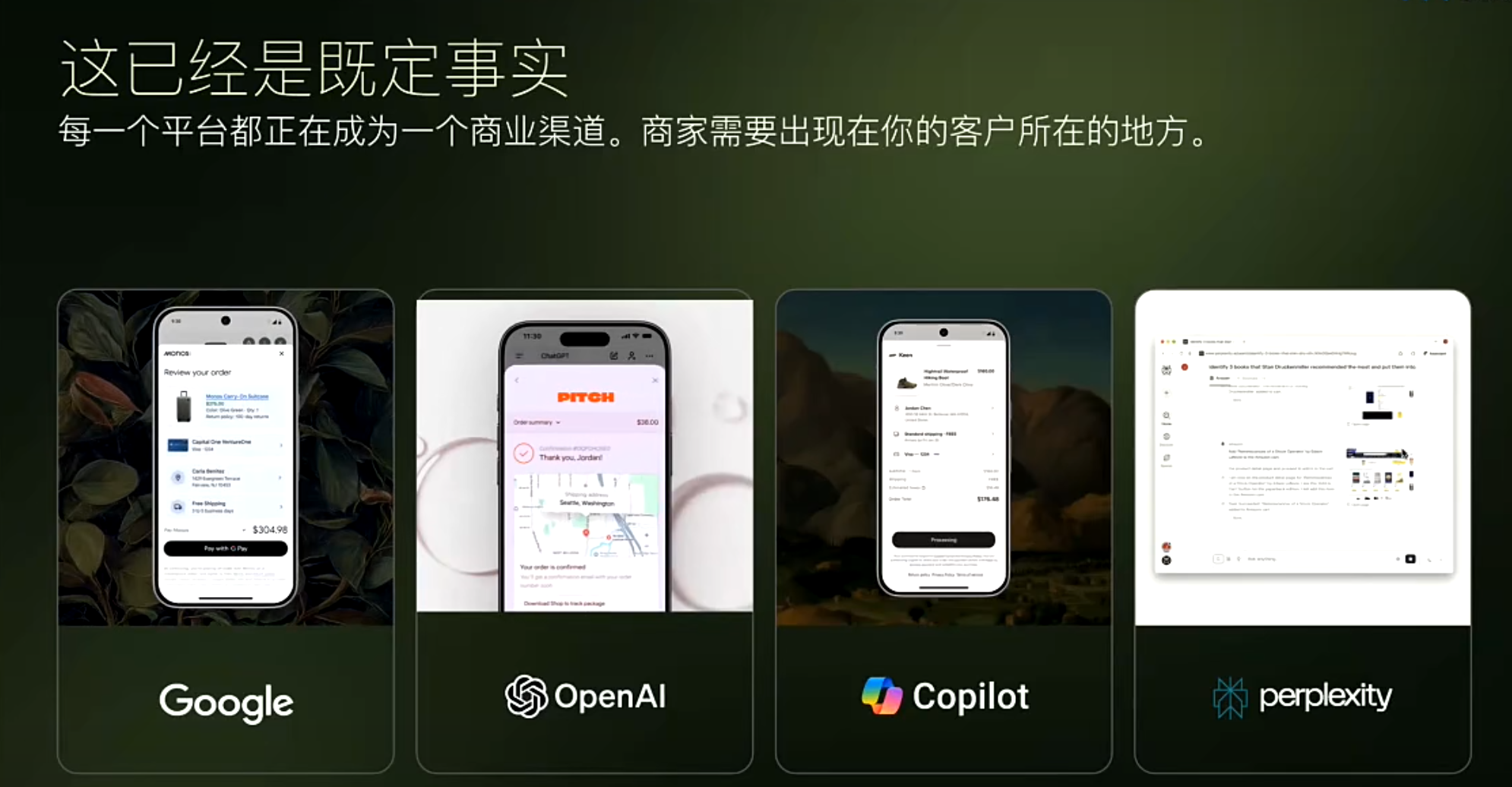
Merchants only need to enable the corresponding authorization switch in the backend to synchronize their product catalog to all major AI platforms currently on the market, including Google, OpenAI, Copilot, and Perplexity. At the same time, merchants retain full control, autonomously deciding which products are sold via AI channels, on which AI channels they are listed, and which products to exclude.
All order information generated from AI channels is automatically aggregated into the merchant backend and can be attributed independently by AI channel. Customer communication and fulfillment processes remain entirely consistent with before, with no changes.
According to Yan Liang, the realization of the above process stems from the synchronization of three aspects in Shopify's backend: First, through the Shopify Catalog (i.e., product catalog), ensuring all products can be discovered by AI agents; Second, through the Universal Commerce Protocol (UCP, the underlying technology connecting numerous AI platforms and merchants, similar to how browsers and servers communicate via HTTP, defining the communication standards between AI agents and merchants, including processes like product discovery, adding to cart, payment, and delivery), completely preserving merchant business logic, such as discount rules, membership points, delivery policies, and other important information; Third, through the unified management backend of Shopify, providing merchants with an extremely simple user experience for accessing GEO traffic.
In other words, the Shopify Catalog, UCP, and unified management backend together constitute Shopify's Agentic Commerce.
According to Yan Liang, currently, Shopify's Agentic Storefront has integrated with almost all major AI platforms on the market, including Google, OpenAI, Microsoft Copilot, and Perplexity. And in January this year, according to Shopify internal data, checkouts initiated via AI agents exceeded 1 million, resulting in 350,000 orders.
Although Agentic Commerce is still an emerging channel, consumers are quickly learning to try it out. "Consumer shopping patterns are shifting from 'browse and click' to 'ask and buy,' with transactions completed within conversations," Yan Liang stated. "Merchants who can accurately present their brand and products in AI conversations, achieve structured data, and maintain contextual integrity will be the first to capture the dividends of the AI e-commerce era."
[Copyright Notice] Ebrun advocates respecting and protecting intellectual property rights. Without permission, no one is allowed to copy, reproduce, or use the content of this website in any other way. If any copyright issues are found in the articles on this website, please provide copyright questions, identification, proof of copyright, contact information, etc. and send an email to run@ebrun.com. We will communicate and handle it in a timely manner.
Translated by AI. Feedback: run@ebrun.com