
Anker Innovations 2025 Annual Report: Revenue Breaks 300 Billion Yuan for First Time, Growth Slows, but Cash Flow Shows Rapid Recovery
[Ebrun Exclusive] April 10, news: Global consumer electronics brand Anker Innovations recently released its 2025 annual financial report, showing stable performance.
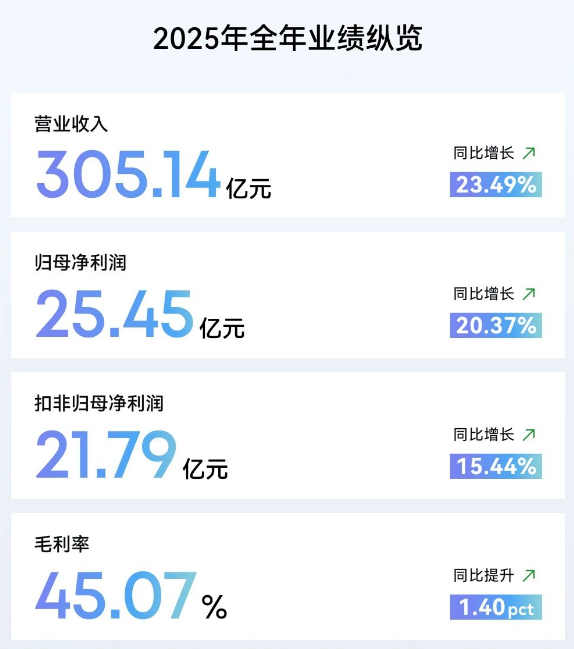
The report indicates that in 2025, the company achieved annual operating revenue of 30.514 billion yuan, a year-on-year increase of 23.49%; net profit attributable to shareholders of the listed company was 2.545 billion yuan, up 20.37% year-on-year; net profit after extraordinary items attributable to shareholders was 2.179 billion yuan, up 15.44% year-on-year; gross profit margin reached 45.07%, an increase of 1.40 percentage points year-on-year.
I. Strengthening Internal Operations: The 'Rapid Profit Growth Phase' Ends, but Expense Structure and 'Cash Flow Bleeding' Show Significant Improvement
Overall, Anker delivered a solid report card for 2025: revenue and profits continued 'double growth', core business operations were stable, and the fundamentals were solid.
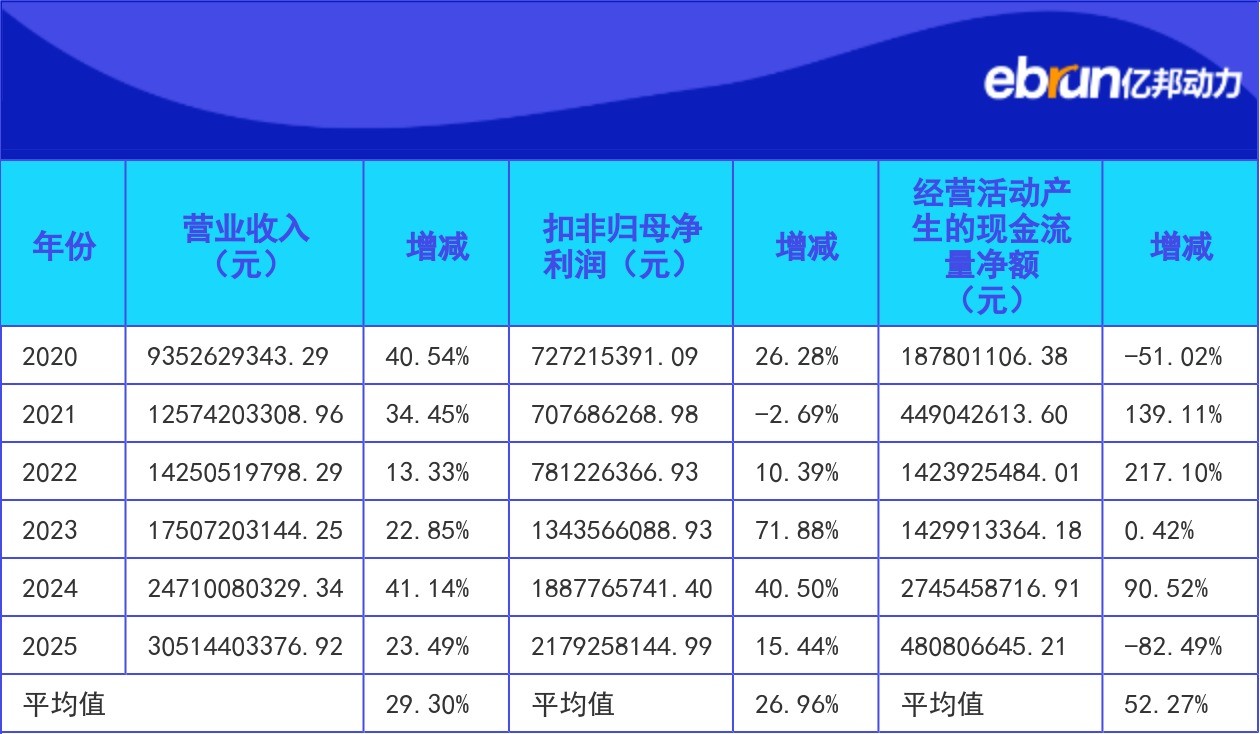
However, examining the structural changes over a longer time horizon reveals that after two consecutive years of substantial profit growth in 2023 and 2024, Anker's profit momentum saw a noticeable decline in 2025:
its full-year net profit after extraordinary items attributable to shareholders was 2.179 billion yuan, a year-on-year increase of 15.44%, significantly lower than the high growth rates of 71.88% and 40.50% in the previous two years, and has fallen below the company's average growth rate since its IPO six years ago. In terms of revenue, the 23.49% year-on-year increase, while still robust, is also below the historical average level.
| Year | Operating Revenue (Yuan) | YoY Change | Net Profit After Extraordinary Items Attributable to Shareholders (Yuan) | YoY Change | Net Cash Flow from Operating Activities (Yuan) | YoY Change |
| 2020 | 9,352,629,343 | 40.54% | 721,539,109 | 26.28% | 780,110,638 | -51.02% |
| 2021 | 12,574,203,308 | 34.45% | 768,626,898 | -2.69% | 904,261,360 | 139.11% |
| 2022 | 14,250,519,798 | 13.33% | 1,226,366,931 | 10.39% | 2,392,548,401 | 217.10% |
| 2023 | 17,507,203,144 | 22.85% | 4,356,608,893 | 71.88% | 2,991,336,418 | 0.42% |
| 2024 | 24,710,080,329 | 41.14% | 8,776,574,140 | 40.50% | 4,545,871,691 | 90.52% |
| 2025 | 30,514,403,376 | 23.49% | 7,925,814,499 | 15.44% | 808,066,452 | -82.49% |
| Average | 29.30% | Average | 26.96% | Average | 52.27% | |
However, Anker performed excellently in terms of expense structure: effective control of operating expenses and continued increased investment in R&D – 'using resources where they are most needed'.
Its selling expenses increased by 22.57% year-on-year, down from the previous year's 43.31% increase, indicating a significant reduction in the tendency for 'marketing-driven growth'; general and administrative expenses increased by 25.82% year-on-year, also showing a marked improvement compared to the previous year's 48.96% increase; R&D expenses further increased to 2.893 billion yuan, up 37.20% year-on-year, accounting for 9.48% of the operating revenue for the same period.
Focusing on R&D, as of the end of 2025, the company held a total of 308 invention patents, 1,286 utility model patents, and 1,432 design patents globally.
During the reporting period, the number of R&D personnel reached 3,549, a significant increase of 32.82% compared to the previous year, now accounting for 56.30% of the company's total workforce. The size of the R&D team has maintained continuous growth since the IPO, expanding more than 3.5 times compared to 2020. Furthermore, the team shows significant trends towards youth and specialization, with researchers under 30 years old accounting for 37.59%, and the number of PhD researchers increasing by 376.19% within a year, providing strong intellectual support for technological innovation.
Regarding cash flow pressure, although the net operating cash flow in 2025 saw a significant decline, dropping 82.49% year-on-year, compared to the negative cash flow of -1.132 billion yuan (a plunge of 234.58% year-on-year) reported in the interim report, this figure had turned positive by the end of 2025, reaching 481 million yuan.
This indicates that after the concentrated sales collections in the fourth quarter initiated the 'recovery' process, the 'bleeding' trend of cash flow has been significantly curbed.
However, looking at Anker's historical data performance, 2025 still marks its first negative cash flow growth since 2021 – the characteristic of phased pressure cannot be ignored. According to the explanation in its third-quarter report, this was primarily caused by two main factors.
First, cash payments to employees – especially in the R&D department – increased significantly, impacting operating cash outflows.
Second, the company proactively conducted large-scale inventory buildup in response to the peak season and tariff wars, directly leading to a 90.11% surge in inventory balance by the end of Q3 compared to the beginning of the year, occupying substantial cash.
However, this issue has now been significantly improved. By the end of 2025, Anker's inventory as a percentage of total assets had decreased to 24.90%, with its balance increasing only about 5.43% compared to the beginning of the year.
On the other hand, analysts also pointed out that recent product recall incidents faced by Anker Innovations in some markets have brought additional remediation costs and funding pressures.
It is reported that since last June, Anker has successively conducted multiple rounds of recalls in the US, China, Japan, and other regions, cumulatively affecting over 2.38 million products. Preliminary estimates by some analysts suggest the direct recovery costs generated thereby range between approximately 432 million to 557 million yuan.
II. Charging and Energy Storage Still Account for Half, Smart Innovation Category Shows Outstanding Growth, Multiple Products 'Pioneer and Break Records'
In 2025, Anker Innovations' three product lines – Charging and Energy Storage, Smart Innovation, and Smart Audio-Visual – all developed steadily.
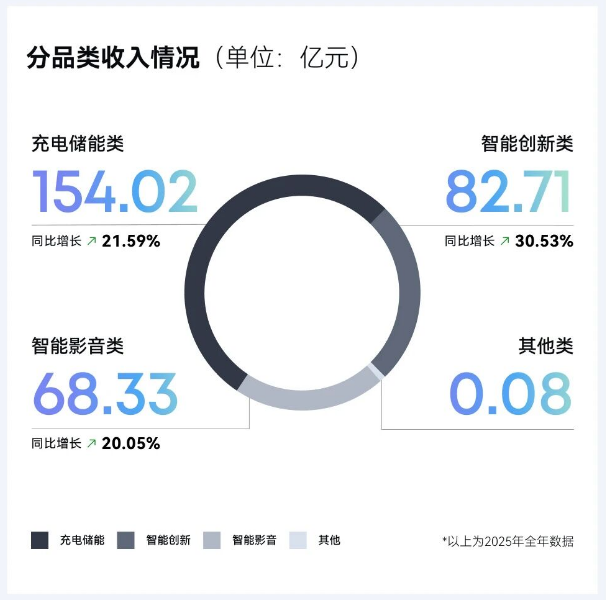
By business segment, Charging and Energy Storage revenue was 15.402 billion yuan, up 21.59% year-on-year, accounting for 50.47% of total revenue, remaining the company's most important revenue pillar. Smart Innovation revenue was 8.271 billion yuan, up 30.53% year-on-year, accounting for 27.11% of total revenue, with the highest growth rate among the three businesses. Smart Audio-Visual revenue was 6.833 billion yuan, up 20.05% year-on-year, accounting for 22.39% of total revenue.
Focusing on the product level, Anker intensively launched numerous innovative products over the past year, a significant portion of which have received positive market feedback, validating its product strength and innovation pace effectiveness.
For example, in the Charging and Energy Storage category, Anker advanced on 'dual tracks' in digital charging and consumer-level energy storage.
In April, China's mandatory national standard 'Technical Specification for Safety of Mobile Power Sources' was released; Anker participated deeply in the formulation of all items of the new standard and was the first to pass the new standard's complete machine testing. In September, the company launched the new generation Anker Prime series at the IFA exhibition, dubbed the 'world's most compact 160W multi-port charger'.
Simultaneously, Anker SOLIX also launched several innovative products in 2025, covering segments such as home backup power and mobile energy storage, outdoor camping, balcony solar storage, and residential energy storage. Among them, the Anker SOLIX C1000 Gen2 portable power station set the global fastest recharge record for a 1kWh portable power station.
In the Smart Innovation category, Anker also made multiple breakthroughs.
In April, the eufy Make UV Printer E1 launched on the Kickstarter crowdfunding platform, setting a Kickstarter historical record with over $46 million in funds raised, ranking first in the 3D printing category.
In July, the world's first PoE security system equipped with a localized Local AI Agent, the eufy NVR S4 Max, was officially launched; by the third quarter, this product ranked first in sales in its category in the UK market, second in the US market, and third in the German market.
In September, the company launched the world's first autonomous stair-climbing assistant device for robot vacuum cleaners, the eufy MarsWalker, for the first time expanding this category's capability for automated cross-floor cleaning.
In the Smart Audio-Visual category, Anker Innovations also actively explored the smart hardware market.
In September, the smart projector Nebula X1 Pro launched on the Kickstarter crowdfunding platform and completed its campaign in November, raising $8.23 million, ranking first in both funds raised and average transaction value in the projector category.
During the same period, the smart open-ear headphones AeroFit 2 AI Assistant were officially released in major European markets, supporting features like high-precision translation for over 100 languages, real-time speech translation, voice commands, and voice search.
Concurrently, the portable wearable AI voice recorder soundcore Work also officially went on sale, being the world's first coin-sized AI smart recording device. In January this year, the China version 'Anker AI Recording Bean' was officially released, achieving deep integration with the Feishu ecosystem.
III. Non-Amazon Channels Develop Steadily, 'Broad AI Strategy' Casts a Wide Net
By sales channel, in 2025, Anker achieved online operating revenue of 21.427 billion yuan, up 21.74% year-on-year; offline operating revenue was 9.087 billion yuan, up 27.81% year-on-year, demonstrating significant results from its omni-channel strategy.
Specifically, the independent website and other online channels contributed 10.27% and 7.66% of total revenue respectively, with year-on-year growth rates of 25.21% and 39.20%, showing stronger growth momentum; meanwhile, Amazon still accounted for the largest share, contributing 52.29% of total revenue, with revenue growing 18.91% year-on-year.
However, compared to the 57.10% share of total revenue in 2023, Anker Innovations' 'Amazon dependency' is continuously declining.
In terms of offline channels, the company continued to improve its global offline sales network, establishing cooperative relationships with global and regional retailers, independent electronics stores, and specialized distributors, while simultaneously advancing its own offline retail store layout.
For different sales channels, the company has established dedicated sales and channel management teams to better match consumer demands in different regions. Currently, the company's products have entered global major chain retailers such as Walmart, Best Buy, Target, and Costco, as well as channels like Argos and OBI in Europe.
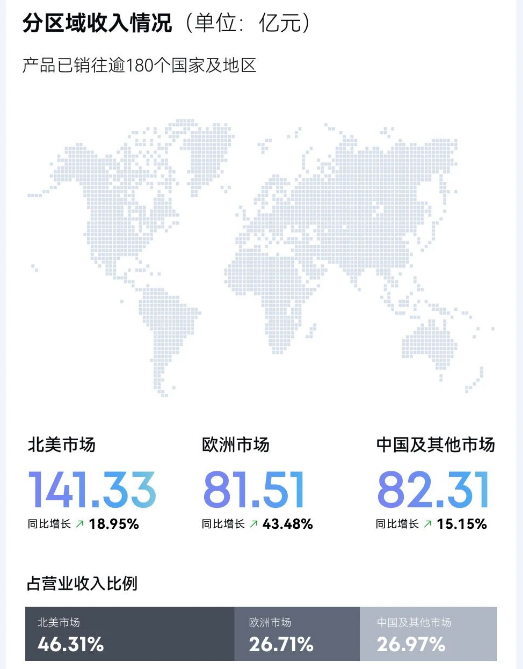
By region, Anker's brand influence and market share in North America remained leading, with revenue reaching 14.133 billion yuan, up 18.95% year-on-year, accounting for 46.31% of revenue, still the absolute mainstay; in the European market, it benefited from regional development opportunities to achieve rapid growth, with revenue reaching 8.151 billion yuan, up 43.38% year-on-year; in China and other markets, revenue was 8.231 billion yuan, up 15.15% year-on-year.
Additionally, particularly noteworthy in this financial report is Anker's 'multi-pronged' 'Broad AI Strategy' layout.
It is reported that since 2023, the company has clarified its 'All in AI' direction, continuously exploring the implementation paths of AI in internal operational efficiency improvements and new product forms.
In 2024, it had already built the AIME intelligent agent platform internally, with the core aim of 'toolizing and popularizing' AI capabilities, enabling employees in non-technical roles such as marketing, customer service, and supply chain to directly utilize them, thereby breaking the boundary of AI serving only the R&D side.
In the R&D system, the company also accelerated restructuring: since 2023, it has promoted a self-developed plugin-based programming system, with code adoption reaching 30% that year, rising to 37% in 2024, and exceeding 50% by 2025, continuously improving R&D efficiency and engineering capabilities.
Simultaneously, Anker is also advancing AI productization at a level closer to business scenarios, embedding related capabilities into its core smart hardware system. For example, it is conducting multi-dimensional upgrade explorations around on-device models, attempting to form differentiated advantages in product experience and technical pathways.
For instance, in the balcony photovoltaic energy storage field, the Anker SOLIX Solarbank 3E 2700 Pro, combined with Anker Intelligence? AIEMS (AI Energy Management System) technology, intelligently optimizes charging, discharging, and energy storage strategies, more precisely regulating household electricity usage to help users reduce energy costs.
In the home security field, in September 2025, the company launched the world's first home-grade AI computing hub, the eufy AI Core, at the IFA exhibition in Berlin, Germany. This product is equipped with the eufy local AI intelligent agent Edge Agent, which can proactively identify multiple types of security scenarios and achieve data storage through the HomeBase local base station to enhance system synergy and privacy protection.
In terms of system-level products, the eufy Expert Secure System became the industry's first intelligent security system integrating a local AI Agent with 7x24 human expert monitoring. This system uses the HomeBase Professional as the intelligent hub, unifying the management of cameras, doorbells, sensors, and alarms through multi-protocol wireless and wired connections, promoting the evolution of home security products from single-point devices towards integrated, proactive solutions.
In the creative printing field, in September 2025, the company released the upgraded Make It Real AI design tool, supporting multi-modal inputs like sketches, photos, and text, further simplifying the process from creative conception to physical object generation, focusing on building a hardware-software integrated creative ecosystem.
It is reported that Anker Innovations was founded in 2011 and officially listed on the ChiNext board of the A-share market on August 24, 2020, known as the 'first stock of cross-border e-commerce'. Its portfolio includes sub-brands such as Anker brand digital charging devices, eufy brand smart home products, Soundcore brand audio equipment, Nebula brand projection equipment, and AnkerMake brand 3D printing products.
Ebrun will continue to track and report on this information. To learn more related to this article, please scan the QR code to follow the author's WeChat.

[Copyright Notice] Ebrun advocates respecting and protecting intellectual property rights. Without permission, no one is allowed to copy, reproduce, or use the content of this website in any other way. If any copyright issues are found in the articles on this website, please provide copyright questions, identification, proof of copyright, contact information, etc. and send an email to run@ebrun.com. We will communicate and handle it in a timely manner.
Translated by AI. Feedback: run@ebrun.com