
SHEIN to Restrict US Merchant Self-Fulfillment in Early-Mid April, Strengthening Logistics Control
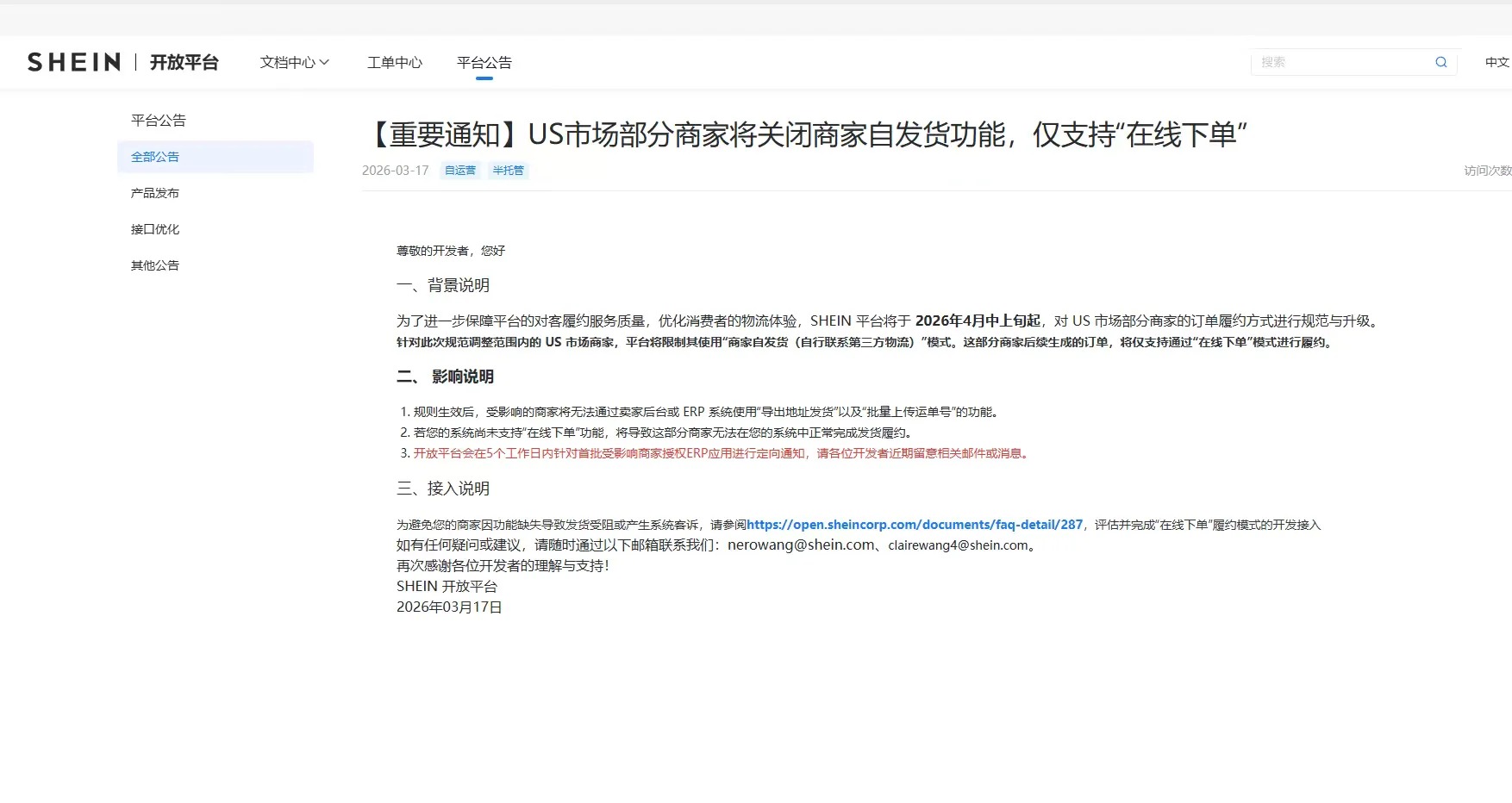
Ebrun Exclusive: Recently, SHEIN announced that it will disable the self-fulfillment function for some US merchants in early to mid-April, supporting only the "online order" fulfillment mode. After this rule takes effect, affected merchants will no longer be able to use the "export address for shipping" and "batch upload tracking number" functions via the seller backend or ERP systems.
Merchant self-fulfillment refers to the model where merchants export order shipping addresses and independently commission third-party logistics providers for shipment. In contrast, the "online order" mode requires using platform logistics. The specific process involves merchants placing orders through the platform; after order placement, the platform contacts partnered logistics providers, who then pick up packages from the merchant's warehouse and deliver them to consumers.
Additionally, SHEIN is enhancing the assessment and optimization of merchant self-fulfillment, stating that starting March 23, 2026, it will strengthen controls by adding evaluations for delayed shipments and orders with valid tracking. Products and stores with delayed shipments will face platform penalties, while abnormal valid tracking rates may result in restrictions on product or store functions.
SHEIN's adjustment of the shipping model for US merchants indicates the platform is further strengthening control and integration of the logistics chain. For merchants, the narrowing of self-fulfillment permissions reduces their logistics autonomy but also provides more stable fulfillment support through the platform's consolidated logistics. For consumers, unified platform logistics helps improve delivery efficiency and service quality consistency, enhancing the shopping experience.
In fact, using official shipping labels has become a unified trend among major cross-border platforms. For example, since last October, TikTok Shop US has mandated that orders shipped via USPS must use official shipping labels printed through the platform's system, otherwise facing penalties such as a $100 fine per order and suspension of self-fulfillment privileges. Since April 2025, Temu US has completely disabled third-party self-fulfillment like FedEx, and starting April 10 this year, its Canadian site will also no support FedEx for self-fulfillment.
From TikTok Shop to Temu and SHEIN, standardizing logistics fulfillment and combating "water-running labels" and "fake shipping labels" have become common directions for platforms. This further reminds merchants that proactively adapting to the platform's standardized and centralized logistics trends is an inevitable choice for ensuring stable store operations.
Ebrun will continue to track and report on this development. To learn more information related to this article, please scan the QR code to follow the author's WeChat.

[Copyright Notice] Ebrun advocates respecting and protecting intellectual property rights. Without permission, no one is allowed to copy, reproduce, or use the content of this website in any other way. If any copyright issues are found in the articles on this website, please provide copyright questions, identification, proof of copyright, contact information, etc. and send an email to run@ebrun.com. We will communicate and handle it in a timely manner.
Translated by AI. Feedback: run@ebrun.com