
U.S. to Investigate Impact of Revoking China's Permanent Normal Trade Relations Status
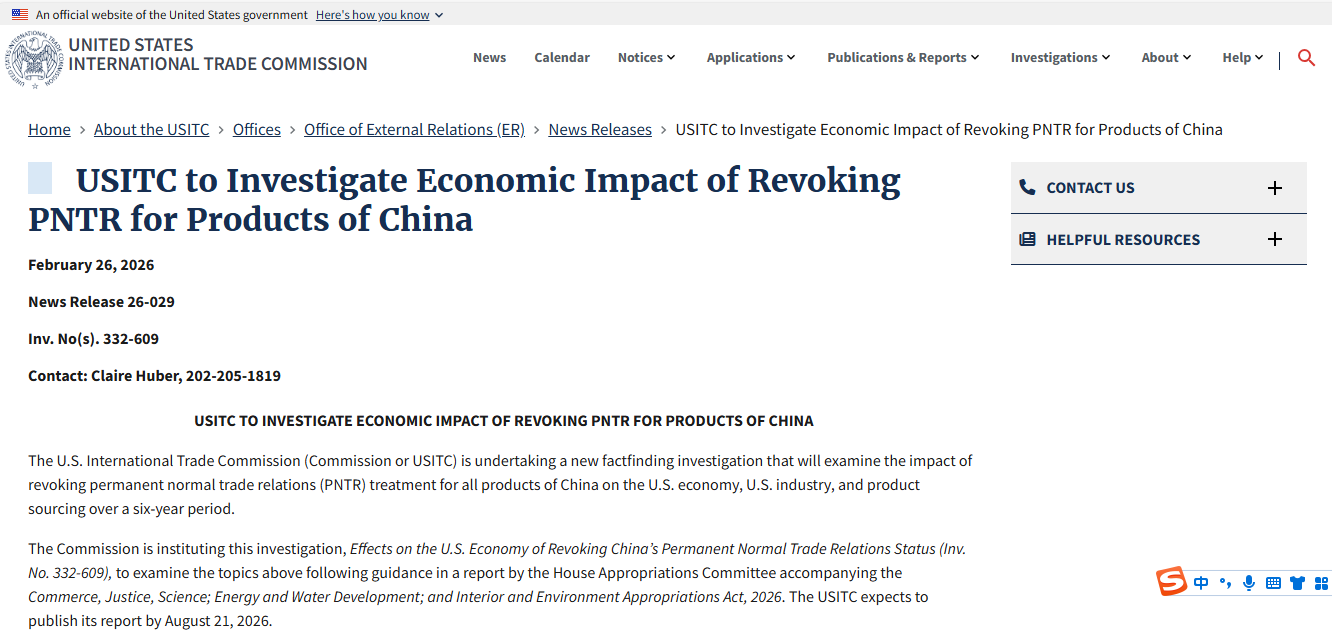
【Ebrun Original】On February 26, the U.S. International Trade Commission (USITC) announced it will launch an investigation into the potential economic impact of revoking China's Permanent Normal Trade Relations (PNTR) status, a move that could lead to significantly higher tariffs on Chinese imports. The agency stated the investigation is mandated by a congressional appropriations bill, with a final report due by August 21 this year.
Since taking office in January 2025, President Trump has repeatedly directed trade and commerce departments to evaluate legislative proposals for terminating China's PNTR status.
This status was initially granted by the U.S. Congress in 2000, paving the way for China's accession to the World Trade Organization (WTO). Since then, Chinese goods have enjoyed Most-Favored-Nation (MFN) tariff treatment in the U.S., with base rates remaining relatively low.
However, the Trump administration initiated a new round of tariff actions against China starting from its first day in office, with the combined tariff rate on some Chinese imports reaching as high as 145% last year. Notably, all previously imposed punitive tariffs were additional levies on top of the standard MFN base rate: before the 2018 trade war began, the average MFN tariff applied to Chinese goods by the U.S. was only about 2.5%.
If China's PNTR status is revoked, the U.S. would apply "non-MFN" rates, known as Column 2 rates, to Chinese goods, which are fundamentally different from current MFN rates.
Currently, the overall U.S. average MFN tariff is only 2% to 3%, while Column 2 rates are typically 20% to 40%, and even higher for certain categories—for example, some textiles can face rates nearing 90%.
Analysts note the gap between the two rate structures often exceeds tenfold. If PNTR is revoked, the base tariff rate for Chinese goods would jump directly from the MFN level to the Column 2 level, on top of which additional punitive tariffs (such as those under Section 301) could still be imposed, replacing previously ruled illegal emergency tariffs. Overall, the combined tariff rate would be far higher than current levels.
The U.S. International Trade Commission is responsible for the study's report. It claims the investigation will focus on assessing the "direct and most significant impacts" on trade flows, production output, and price levels for relevant U.S. industries if higher Column 2 tariffs are applied to Chinese goods.
Simultaneously, the report will also examine another policy scenario: if Congress revokes PNTR treatment, tariffs on products critical to national security could be phased in gradually over five years to mitigate short-term shocks.
To gather input, the USITC has publicly invited stakeholders to submit written comments on the impact of raising tariffs on Chinese goods by the close of business on April 13. Due to the tight schedule, the Commission stated it will not hold public hearings.
Observers believe this investigation is not only the latest signal of the Trump administration's push for further tightening of trade policy towards China but also indicates that U.S.-China economic and trade relations may face deeper structural adjustments. The final conclusions will provide important reference material for subsequent congressional legislation.
Ebrun will continue to track this development. To learn more related information, please scan the QR code to follow the author's WeChat.

[Copyright Notice] Ebrun advocates respecting and protecting intellectual property rights. Without permission, no one is allowed to copy, reproduce, or use the content of this website in any other way. If any copyright issues are found in the articles on this website, please provide copyright questions, identification, proof of copyright, contact information, etc. and send an email to run@ebrun.com. We will communicate and handle it in a timely manner.
Translated by AI. Feedback: run@ebrun.com