
TikTok Shop Releases AI-Generated Content Rules: Clarifies Usage Standards and Penalties; Compliant Content Won't Be Throttled
[Ebrun Original] Recently, TikTok Shop has introduced new regulations, stating that AI-generated content is permitted as long as it complies with the "TikTok Shop Content Policy" and the "TikTok Community Guidelines". The platform has set clear standards for merchants and creators using AI tools and has also outlined penalties for violations.
According to the new rules, AI-generated content refers to videos, images, audio, text, or live-stream content that is fully or partially generated, edited, or synthesized using artificial intelligence technology. This includes content that simulates, modifies, or reconstructs people, scenes, or events, as well as content that is entirely fictional or presented in a specific artistic style (such as painting, cartoon, or animation styles). All AI-generated content must adhere to platform rules and fundamental principles.
TikTok Shop emphasized that the platform supports creators in using AI technology for content creation in a reasonable and responsible manner. As long as the content complies with the "TikTok Community Guidelines", TikTok Shop rules, and all relevant platform standards and requirements, the mere use of AI technology will not result in content restrictions or penalties. Permissible use cases for AI include, but are not limited to, visual styles and effects, editing and quality optimization, translation, dubbing, and subtitles, copywriting and script assistance, etc.
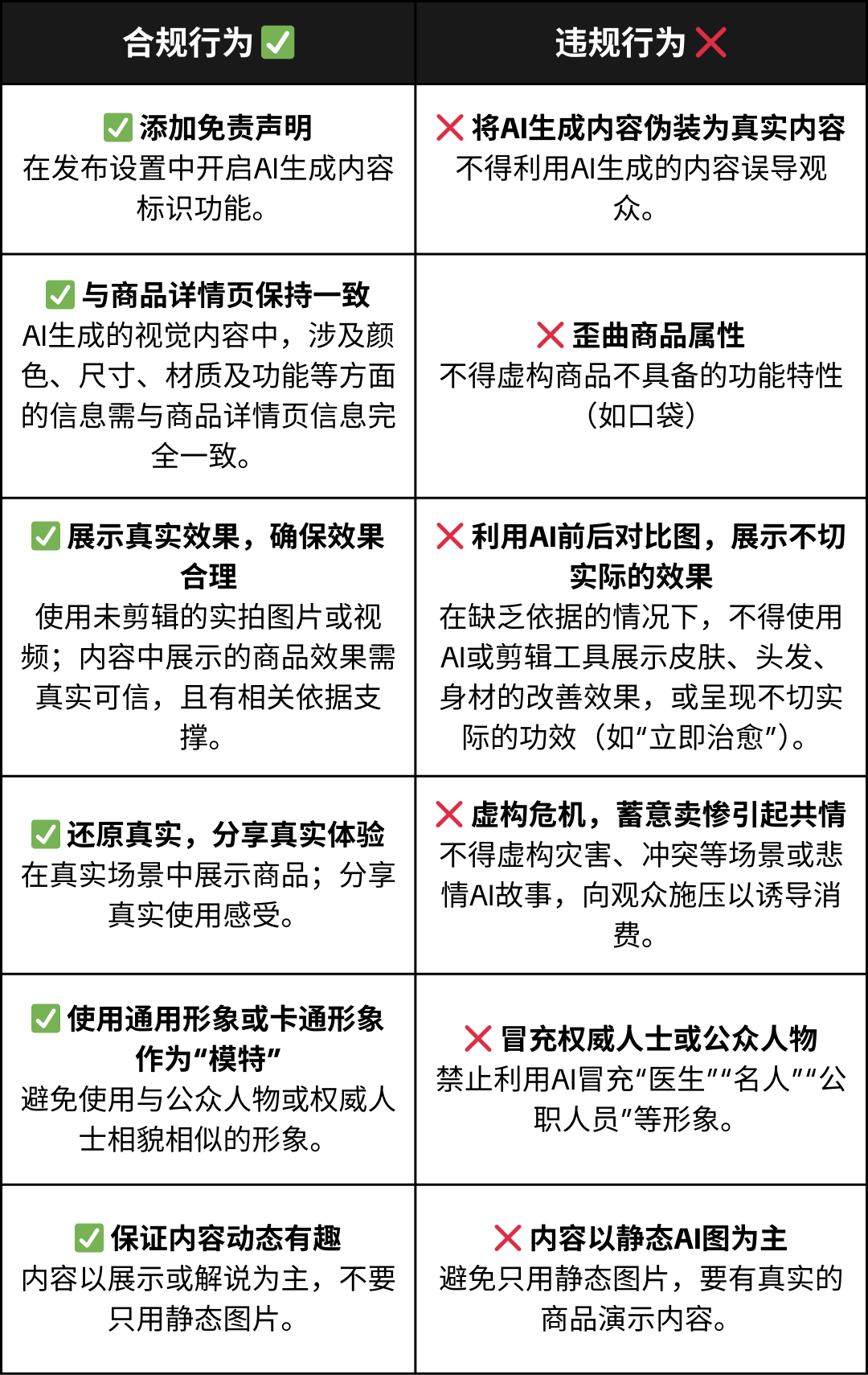
(Notes for AIGC Creation)
However, to ensure information transparency and build user trust, creators must clearly disclose the use of AI technology in their content—either by disclosing within the content (using on-screen text, watermarks, stickers, or adding a note in the video description clearly indicating the content is AI-generated) or by using the platform's disclosure tool (enabling the "AI-generated content" switch when publishing, which will display "Content disclosed by creator as AI-generated" in the lower left corner of the content).
In addition to creator-initiated disclosure, the platform may automatically identify and label some AI-generated content. When AI-generated content contains specific technical metadata, the system will automatically add an "AI-generated" label. Once content is automatically labeled by the platform, creators cannot remove the label. However, content that is automatically disclosed will not face additional penalties or traffic restrictions solely because of the label.
Meanwhile, TikTok Shop explicitly stated in the new regulations that strictly prohibited behaviors for AI-generated content include three main aspects: 1. Misleading or false content (content must be truthful and accurate, must not contain exaggerated, false, or misleading claims, including false advertising or misrepresentation of products); 2. Unauthorized use of third-party rights (without legal authorization, content must not use the likeness, voice, name, trademark, or other intellectual property of third parties); 3. False representation in product promotion (product promotion videos must clearly and accurately display the actual product, must not use AI to replace the product or falsely display it, leading buyers to misunderstand the actual product).
For AI-generated content and related accounts that violate the standards, the platform will implement corresponding penalties.
First, penalties at the account level. Depending on the severity and recurrence of violations, accounts may face different levels of penalties: For first-time violations or violations with minor impact, the platform may issue a warning and require rectification; For accounts repeatedly posting non-compliant content, the platform may impose account restrictions, including limiting posting functions, throttling traffic, or permanently revoking commission withdrawal privileges; For accounts with repeated violations or single violations causing significant negative impact, additional penalties may apply, including suspension or permanent revocation of product promotion privileges; Accounts using AI-generated content to commit fraud, disseminate illegal information, or engage in other serious illegal or non-compliant behaviors will be permanently banned.
Second, penalties at the content level. Using fabricated professional identities and false personas for promotion, using AI to create false or exaggerated product effects, using AI to falsely display products (misrepresentation) are all considered content-level violations. For content violations, the platform will take measures based on the severity of the violation, such as restricting content distribution or exposure, removing product links or shopping cart functions, and deducting corresponding Creator Health Rating (CHR) points.
Furthermore, it is worth noting that an important context for TikTok Shop releasing these AI-generated content rules is the current surge of AI tools, which has lowered the barrier to content creation for merchants and creators. However, this also brings the risk of mixed quality, requiring the platform to strike a balance between content supply and user experience protection. The new regulations acknowledge the objective value of AI technology in filling content gaps and lowering creation barriers, while also curbing misuse by clarifying disclosure obligations and defining prohibited areas. For merchants and creators, "AI content compliance capability" will be a core competitive factor in the future.
[Copyright Notice] Ebrun advocates respecting and protecting intellectual property rights. Without permission, no one is allowed to copy, reproduce, or use the content of this website in any other way. If any copyright issues are found in the articles on this website, please provide copyright questions, identification, proof of copyright, contact information, etc. and send an email to run@ebrun.com. We will communicate and handle it in a timely manner.
Translated by AI. Feedback: run@ebrun.com