
SHEIN's 'Chain Empowerment' Model: Revitalizing Traditional Manufacturing for Global Expansion
 By Han Xiao Edited by Shi Lei
[Ebrun Original] Chen Di has been in the garment industry for thirty years. Starting as a sewing worker, she saved enough capital to start her own processing factory, and later leased a stall in a wholesale market near Guangzhou Railway Station. Business thrived until around 2010, when the rise of e-commerce gradually shifted consumer habits, leading to a sharp decline in orders from the traditional clothing brands Chen served.
Chen still remembers June 6, 2021, the day she officially became a SHEIN supplier. SHEIN introduced her to a completely different set of rules from her three decades of experience, leading her factory into a flexible supply chain model based on on-demand production and "small-batch, quick-response."
SHEIN, which started in 2012 with a direct-to-consumer model, has now developed a dual-engine strategy of "proprietary brands + platform." After over a decade of development, the company has built a "small-batch, quick-response" supply chain system. This system allows suppliers like Chen Di to move away from gambling on hit products, instead testing the market with small batches and quickly replenishing orders based on actual sales data, essentially solving the critical issue of high inventory that plagues the traditional garment industry.
While investing over 10 billion RMB in smart supply chain infrastructure, SHEIN also systematically promotes the digital and intelligent upgrade of China's garment manufacturing through initiatives like the "500 Million RMB over Five Years" supplier empowerment plan and other green, carbon-reduction projects. For Chen Di, this not only means stable orders but also enhances her factory's overall competitiveness in areas like technological innovation, talent training, facility upgrades (both hardware and software), employee welfare, and energy efficiency improvements.
These practices align with the national strategy to promote industrial modernization. The "Implementation Plan for the Digital Transformation of the Textile Industry," jointly issued by six departments including the Ministry of Industry and Information Technology, explicitly states that by 2027, over 70% of key business processes in large-scale textile enterprises should be fully digitalized, using digital transformation to enhance the industry's comprehensive strength and core competitiveness.
In fact, as a core enterprise in the supply chain, SHEIN, by injecting digital DNA into the capillaries of the industrial chain, provides an observational case study and practical example in building a modern industrial system and cultivating new quality productive forces.
01
Production Transformation: From Mass Production to "Small-Batch, Quick-Response"
In a garment factory in Humen, Dongguan, Sun He, a SHEIN women's wear supplier, is using upstream digital heat transfer equipment to achieve "on-demand customization" for individual garments. Digital heat transfer is a printing technique where dye is first printed onto transfer paper and then heat-pressed onto fabric to create patterns. Unlike traditional dyeing machines, this new technology not only consumes zero water but is also ideal for personalized, single-item production.
"Our previous clients increasingly demanded faster turnaround times, and while order quantities gradually decreased, personalized demands grew," Sun He said. This is his tenth year in garment printing in Humen; he has always kept up with trends, starting with OEM work for international brands, later adding fabric supply, and now keenly capturing the trend of personalization by becoming a SHEIN supplier for on-demand customization.
Ebrun research found that since 2020, Print on Demand (POD) has rapidly evolved from a niche demand into a major trend, sweeping across the cross-border e-commerce industry. From T-shirts to mugs and backpacks, almost anything can be customized on demand. Google Trends data shows that consumer interest in the POD model has grown by nearly 300% compared to five years ago.
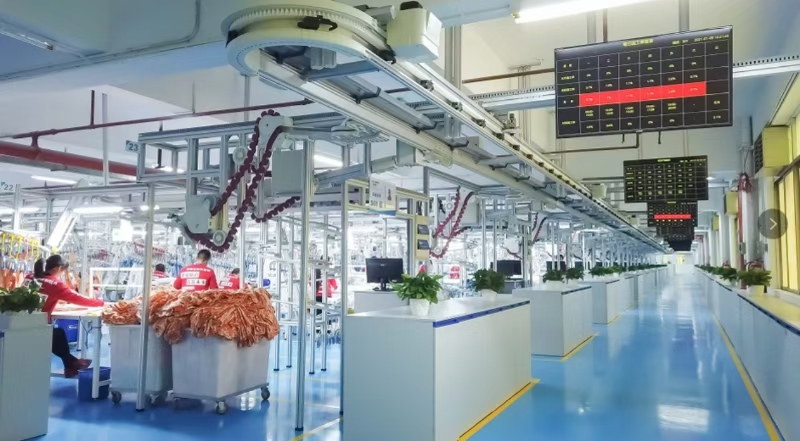
The flexible "small-batch, quick-response" supply chain model perfectly supports this new trend of on-demand customization. Using digital heat transfer equipment, Sun He prints consumer-selected patterns onto garments, meeting personalized demands while significantly reducing inventory and return rates.
It is reported that compared to the industry average inventory rate of 30%, SHEIN's digital flexible supply chain can reduce the inventory rate to single digits. This model offers significant advantages in reducing energy waste, improving industrial efficiency, and lowering operational risks associated with high inventory.
Like Sun He, Yao Yuan, a supplier of sportswear and outdoor apparel, has also recognized the benefits of the flexible supply chain.
Yao Yuan's factory primarily produces delivery worker uniforms. Recently, he noticed increasing demand for limited-edition uniforms featuring IP collaborations, but each order is only for two to three hundred pieces. To address this, he proactively chose to partner with SHEIN to learn the "small-batch, quick-response" production model. With SHEIN's training, Yao Yuan restructured his previous 30-person assembly line into smaller lines of under 10 people each. SHEIN's empowerment team also trained workers on production standards and quality inspection details for different styles, enabling them to adapt to the multi-process operations characteristic of smaller lines.
This refinement of the production process not only successfully expanded new production capacity but also met current market demands for personalization. The transformation driven by the flexible supply chain is profoundly rewriting the production processes of traditional factories and reshaping the industry's competitive landscape and future direction.
02
Technology-Driven: From Tool Innovation to Collaborative Ecosystem
Whether for traditional mass production or the "small-batch, quick-response" flexible supply chain model, continuous operation and optimization rely on ongoing technological innovation. The development and application of new tools and processes have become key to driving industrial digitalization and maintaining core competitiveness.
In traditional garment manufacturing, complex processes like bead embroidery and hotfix rhinestone application have long relied on manual labor, resulting in low efficiency and inconsistent quality. For example, with bead-embroidered fabrics, sewing machine needles easily get stuck on the raised beads, causing frequent breakage. The traditional solution required workers to manually break the beads, which was difficult to control and often damaged the fabric.
Leveraging its leading role in the industrial chain, SHEIN established an Apparel Manufacturing Innovation Research Center to systematically tackle technical challenges. Data shows that by the end of 2025, SHEIN had developed over 180 innovative tools, delivering a total of 7,500 units to suppliers, with an average efficiency improvement of 35%.
For instance, to address the bead embroidery needle breakage issue, it developed the "Bead Embroidery Seaming Presser Foot" and "Flatbed Bead Breaking Kit" technologies. The former automatically pushes beads aside along the sewing path, protecting bead integrity and preventing needle breaks; the latter integrates bead breaking and air blowing functions, facilitating subsequent processes.
SHEIN's technological innovation is not just about isolated breakthroughs but involves building an open, collaborative innovation ecosystem. It actively collaborates with leading universities like Donghua University and top material companies like Transfar Chemicals to jointly tackle core technologies. This deep integration of "industry, academia, research, and application" accelerates the rapid transformation and application of innovations within the industrial chain.
Women's wear supplier Chen Di is a direct beneficiary of this technological empowerment. Her factory previously faced efficiency being halved due to the need for manual edging on sequined fabrics. A tool developed by SHEIN combined two processes into one, immediately boosting production efficiency by 40%, enabling stable delivery of complex styles that were previously difficult to mass-produce.
The benefits of technological innovation are immediate. SHEIN is permeating the results of its innovation into every link of the industrial chain. For suppliers, efficiency gains directly translate into cost and competitiveness advantages; for the entire industry, tool innovation promotes the standardization and leanification of production processes, laying a solid foundation for the stable operation of the flexible supply chain and accelerating the transition from traditional manufacturing to digital-intelligent manufacturing.
03
Industrial Upgrade: From Full-Process Transparency to End-to-End Informatization
For Chen Di, unlike the passive state of actively seeking orders and chasing payments in the traditional model, SHEIN's digital order dispatch, full-process transparency, and stable payment terms have been a strong boost for suppliers like her.
"After completing one order, the delivery date for the next is already scheduled in the system." This certainty allows her to focus on improving craftsmanship and quality, without worrying about order sources.
Furthermore, through the digital system, Chen Di can monitor trend indicators and consumer reviews in real-time, preparing materials in advance for promising styles and continuously optimizing product quality. "Before, the client placed an order and you just made it. The final quality and sales depended entirely on the client's feedback. Now, we can quickly see where problems arise during production and make rapid improvements. It gives us much more confidence!" Chen Di said.
Facing the challenges of order fragmentation and frequent style changes under the "small-batch, quick-response" model, SHEIN has established a comprehensive training system. After a month of training and adaptation, Chen Di's factory can now produce hit products that sell well overseas, with a continuous influx of orders driving factory performance upward.
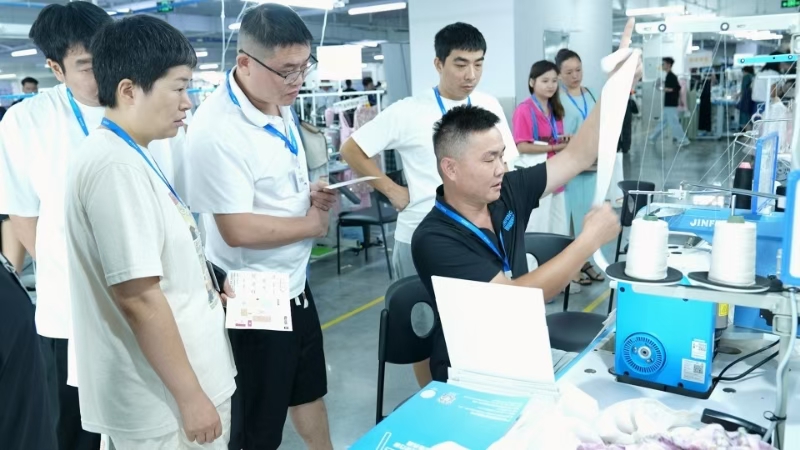
It is understood that in 2025 alone, SHEIN conducted approximately 600 training sessions for suppliers, covering nearly 37,000 participants. In the Xingcheng swimwear industrial cluster in Liaoning, training on pattern-making for complex swimwear reduced size-related defects by nearly 30% among participating suppliers. This targeted, "on-site" empowerment effectively enhanced workers' skills and significantly improved overall operational efficiency.
From development and production to warehousing and logistics, SHEIN assists suppliers with end-to-end digital upgrades, transforming traditional factories reliant on manual labor, Excel, and email into fully digitized operations across the chain. SHEIN has also invested over 60 million RMB cumulatively, helping more than 200 factories upgrade 520,000 square meters of workshop space, benefiting over 33,000 people.
The proposals for the 15th Five-Year Plan suggest optimizing and upgrading traditional industries, including textiles, promoting innovative trade development, and supporting new business formats and models like cross-border e-commerce. Through technological empowerment and digital transformation across the supply chain, SHEIN systematically drives industrial quality improvement and upgrading, providing a replicable reference path for the transition of traditional industries towards digitalization, intelligence, and sustainability.
Ebrun continues to track this development. To learn more related information, please scan the QR code to follow the author on WeChat.

[Copyright Notice] Ebrun advocates respecting and protecting intellectual property rights. Without permission, no one is allowed to copy, reproduce, or use the content of this website in any other way. If any copyright issues are found in the articles on this website, please provide copyright questions, identification, proof of copyright, contact information, etc. and send an email to run@ebrun.com. We will communicate and handle it in a timely manner.
Translated by AI. Feedback: run@ebrun.com